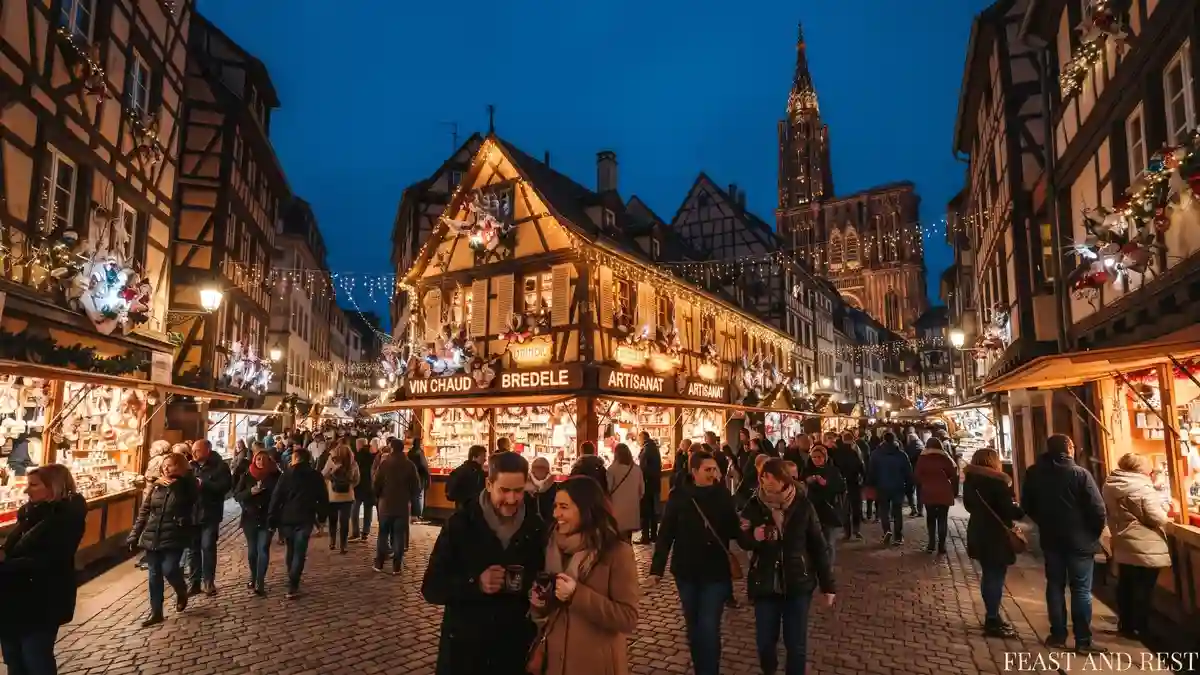
The Strasbourg Christmas market 2026 dates run from Friday, November 27, through Thursday, December 24, 2026. Held across the UNESCO-listed Grande Île, this historic winter festival anchors France winter cultural travel by uniting centuries-old Germanic and French traditions. Travelers use this four-week window to follow a traditional Alsatian food guide, deciding what to eat in Strasbourg winter stalls, booking authentic Alsatian restaurants, or testing choucroute garnie and bredele recipes at home. Beyond the city’s European Christmas market food tour appeal, visitors consult a Strasbourg Cathedral holiday guide, stay in the best boutique hotels in Strasbourg, and plan an Alsace wine route winter itinerary.
Definition: ChristkindelsmärikFounded in 1570, the Christkindelsmärik (“Market of the Infant Jesus”) in Strasbourg is France’s oldest continuous Christmas market. Today, the municipal event spans more than 300 wooden chalets distributed across eight distinct public squares within Strasbourg’s historic center.
Strasbourg Christmas Market 2026 Dates and Official Schedule
According to the Strasbourg Tourist Office and the official Noël à Strasbourg municipal portal, the 2026 edition opens at 2:00 PM on Friday, November 27, and concludes at 6:00 PM on Thursday, December 24. Unlike several neighboring European winter festivals that remain open through New Year’s Eve, all chalets in Strasbourg close permanently on Christmas Eve and remain shut on December 25.
Established during the Protestant Reformation in 1570 to replace the medieval Saint Nicholas market, the festival operates across the Grande Île, an island historic center inscribed on the UNESCO World Heritage List in 1988. The Grand Est Regional Tourist Agency and Atout France classify the event as the country’s largest seasonal cultural gathering, drawing roughly two million visitors annually.
By the Numbers: Strasbourg Winter Season
1570: Founding year of the original Christkindelsmärik
300+: Artisanal and culinary wooden chalets across eight squares
30 meters: Height of the Grand Sapin (Great Christmas Tree) on Place Kléber
€250M+: Estimated regional economic impact reported by Strasbourg tourism authorities
Why This Matters: Cultural Heritage and Cross-Border Identity
Strasbourg’s winter traditions reflect its geographic and historical position along the Rhine River, where French and Germanic governance alternated for centuries. Consequently, France winter cultural travel in Alsace offers a distinct culinary and linguistic heritage that differs markedly from Paris or Provence.
As noted in official municipal heritage documentation from Noël à Strasbourg, “Artisans and exhibitors share their talents here, making Strasbourg, the Christmas Capital, a unique event that blends heritage and creativity.” Because the city limits market vendors to regional food specialties, traditional crafts, and verified social enterprises, the festival serves as a living archive of Alsatian material culture.
Strasbourg Cathedral Holiday Guide and Architectural Access
Towering 142 meters above the market stalls, the Cathédrale Notre-Dame de Strasbourg anchors the city’s winter sightseeing. Constructed primarily between 1176 and 1439 from pink Vosges sandstone, the monument remains the centerpiece of any Strasbourg Cathedral holiday guide.
During Advent, the cathedral maintains free general entry for visitors outside of liturgical services, while the 330-step climb to the viewing platform offers panoramic vistas over the illuminated Grande Île. Inside the nave, the parish displays its historic collection of 17th-century tapestries depicting the life of the Virgin Mary—a seasonal tradition maintained since 1739. Visitors also gather daily at 12:30 PM to observe the Renaissance astronomical clock’s automated procession of the apostles.
Traditional Alsatian Food Guide: What to Eat in Strasbourg Winter
Navigating a European Christmas market food tour in Strasbourg requires understanding the region’s dual culinary personality: quick handheld market snacks and slow-cooked tavern meals.
Essential Market Street Foods
When deciding what to eat in Strasbourg winter chalets, visitors encounter specialties shaped by cold-weather preservation and spice trade routes:
Vin Chaud Blanc: Unlike standard red mulled wine, Alsatian stalls simmer local Pinot Blanc or Sylvaner wine with cinnamon, star anise, cloves, and citrus. Drinks are served in reusable deposit cups (écocups).
Tarte Flambée (Flammekueche): Rolled bread dough baked in wood-fired ovens with fromage blanc, thinly sliced onions, and smoked bacon lardons.
Pain d’Épices: Dense honey-and-spice bread sold by heritage houses such as Mireille Oster in Strasbourg and Fortwenger from nearby Gertwiller.
Mannele (or Maennele): Brioche rolls shaped like small figures, baked specifically around Saint Nicholas Day on December 6.
Berawecka: A dense, dark loaf of dried pears, figs, prunes, and nuts macerated in local fruit brandy (eau-de-vie) and bound with minimal spiced dough.
Authentic Alsatian Restaurants and Winstubs
For seated dining away from outdoor crowds, travelers seek out a winstub—historically a winemaker’s tasting room that evolved into a wood-paneled neighborhood tavern. Native Alsatian culinary writer Céline Honoré defines the institution as “a traditional Alsatian restaurant (literally ‘wine room’), recognizable by its warm, rustic, wood-paneled decor, where regional culinary specialties are served.”
Established addresses near the cathedral and Petite France—such as Au Pont Corbeau, Winstub Le Clou, Le Tire-Bouchon, and La Vieille Enseigne—serve regional mainstays including baeckeoffe (a slow-baked casserole of marinated pork, beef, lamb, and potatoes) and fleischschnacka (rolled pasta pinwheels stuffed with braised meat). Reservations are typically required several weeks in advance for December evenings.
Choucroute Garnie and Bredele Recipes: Culinary Foundations
Two dishes define Alsatian winter gastronomy both in local kitchens and across home cookbooks: choucroute garnie and bredele. Understanding their preparation clarifies why Alsatian cuisine relies on fermentation, aromatic spices, and regional white wines.
Choucroute Garnie (Braised Sauerkraut with Charcuterie)According to culinary archives from the James Beard Foundation and regional Alsatian culinary guides, authentic choucroute garnie balances the acidity of fermented white cabbage with smoked and salted pork cuts:
Rinse and Season: Cold-water rinse 1 kilogram of raw fermented cabbage to moderate its acidity, then layer it in a heavy Dutch oven with duck fat or lard, juniper berries, cloves, garlic, and a bouquet garni.
Braise in Riesling: Pour 250 milliliters of dry Alsatian Riesling and meat stock over the cabbage, nestling smoked pork shoulder (palette) and cured bacon (lard fumé) inside. Simmer covered for 90 minutes.
Finish with Sausages: Add steamed potatoes during the final 30 minutes and gently poach smoked Montbéliard sausages and Strasbourg knacks on top for the last 10 minutes before serving with sharp mustard.
Bredele (Alsatian Advent Biscuits)Bredele (spelled bredle in Bas-Rhin and bredala in Haut-Rhin) are small butter cookies baked throughout Advent in dozens of distinct varieties. Traditional butterbredele combine creamed butter, sugar, egg yolks, and flour flavored with lemon zest or vanilla, brushed with egg wash before baking until golden. Other classic variations include anisbredele (aniseed drops with crisp meringue tops) and schwowebredele (spiced almond-and-cinnamon cutouts).
Alsace Wine Route Winter Itinerary and Regional Excursions
While Strasbourg serves as the primary rail hub—located 1 hour and 45 minutes from Paris Gare de l’Est via TGV—pairing the city with an Alsace wine route winter itinerary reveals smaller medieval wine villages. Regional TER trains connect Strasbourg to Colmar in approximately 30 minutes, while rental cars or organized excursions allow access to hillside vineyards.
Day 1 – Strasbourg Grande Île: Walk the historic squares from Place Broglie to Petite France, tour Strasbourg Cathedral, and dine in a historic winstub.
Day 2 – Obernai and Gertwiller: Travel 30 minutes south to Obernai’s market (open through December 31, 2026) and visit the gingerbread workshops and museums in Gertwiller.
Day 3 – Riquewihr, Kaysersberg, and Colmar: Explore the Grand Cru vineyards surrounding Riquewihr and Kaysersberg before visiting Colmar’s six themed markets (operating November 23 through December 29, 2026).
Comparative Winter Destinations in the Upper Rhine
Travelers evaluating European winter markets often compare Strasbourg with neighboring cities across the French-German border:
Best Boutique Hotels in Strasbourg and Seasonal Planning
Accommodations inside the Grande Île sell out months ahead of late November, with nightly rates often doubling on December weekends compared to late-November weekdays. Travelers researching the best boutique hotels in Strasbourg generally prioritize soundproofing, proximity to pedestrian zones, and historic architecture.
Historic & Canal-Side Properties: Hôtel & Spa Régent Petite France occupies a converted 17th-century ice factory overlooking the Ill River canals, while Hôtel Gutenberg sits steps from Place de la Cathédrale.
Design-Forward & Wine-Focused Stays: Hôtel Hannong on Rue du 22 Novembre features a dedicated regional wine bar, and Hôtel Léonor occupies a renovated 18th-century building near Place Broglie.
Transit-Convenient Boutique Options: Hôtel Tandem, located opposite the Strasbourg TGV station, emphasizes sustainable hospitality within a short walk of Petite France.
For smoother pedestrian access, municipal officials recommend visiting between Monday and Thursday, when crowd density drops significantly compared to Friday evenings and Saturdays.
What the Data Shows: Sustainability and Community Impact
Managing two million seasonal visitors within a compact medieval island presents significant environmental and civic challenges. In 2025, Strasbourg became the first municipality to earn ISO 20121 certification for sustainable event management specifically for its Christmas market operations.
According to Noël à Strasbourg sustainability reports, municipal authorities implemented several structural reforms to achieve certification and protect local quality of life:
Pedestrian and Transit Controls: Vehicular access to the Grande Île is restricted during market hours, supported by peripheral Park-and-Ride (P+R) tram hubs and 600 kilometers of regional cycling infrastructure.
Circular Economy Initiatives: Since 2015, the Marché OFF on Place Grimmeissen has dedicated stall space to social-solidarity enterprises, zero-waste workshops, and upcycled goods.
Energy and Waste Reduction: All municipal holiday illuminations operate on low-consumption LED networks with scheduled nighttime shutoffs, while reusable deposit cups eliminate single-use plastic waste across food squares.
As the official Noël à Strasbourg sustainability charter states, the city’s objective is to ensure that Strasbourg “continues to reduce its ecological footprint without sacrificing the magic,” balancing international cultural tourism with year-round residential livability.
Stay inspired with Feast and Rest!