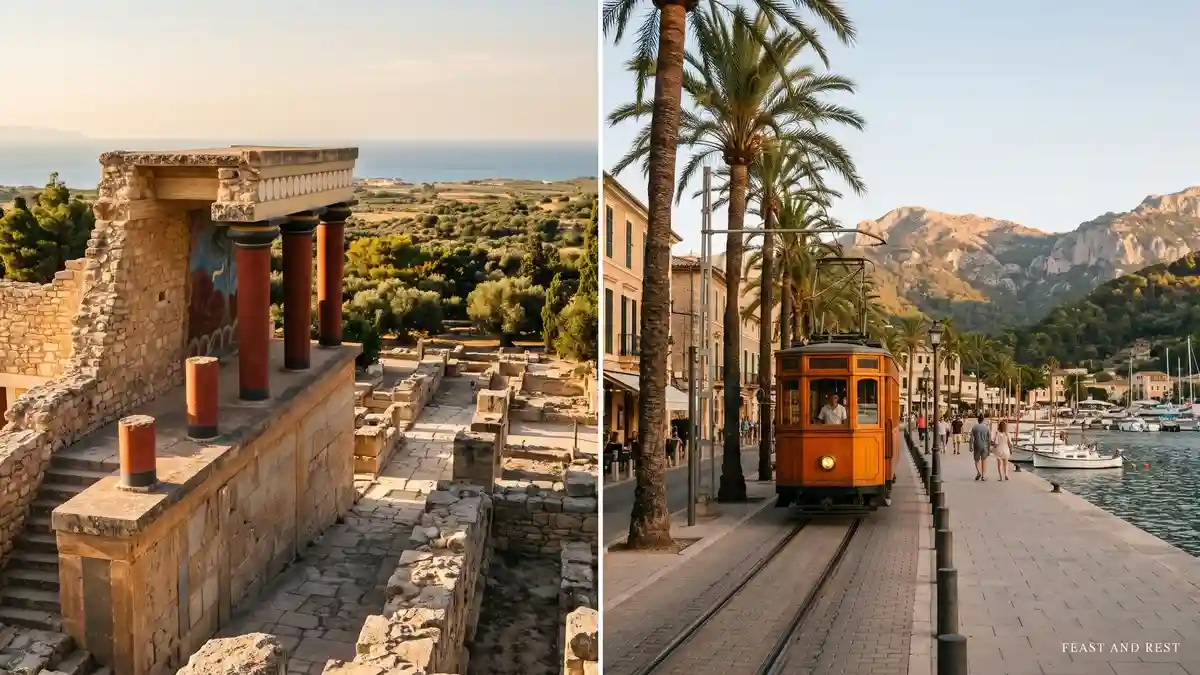
A Crete vs Mallorca vacation comparison examines two of Europe’s largest Mediterranean islands, weighing Greece’s sprawling Bronze Age heartland against Spain’s compact Balearic stronghold for cultural and heritage travelers. Both islands lead the market for best European island escapes, yet they diverge sharply in geographical scale, historical timelines, and daily travel rhythms. While travelers frequently compare Mallorca vs Greek islands broadly, choosing between Crete and Mallorca comes down to distinct experiences—from booking affordable Crete luxury hotels and a Cretan food and wine tour, to mapping out a Port de Soller Mallorca travel guide or visiting the best beach clubs Mallorca 2026 has to offer among Mediterranean shoulder season destinations.
In practical terms, a Crete vs Mallorca vacation comparison contrasts a 8,336-square-kilometer Greek island defined by newly inscribed Minoan archaeological sites with a 3,640-square-kilometer Spanish island anchored by a UNESCO-listed mountain range and streamlined infrastructure. Data from the Balearic Statistics Institute (IBESTAT), the Greek Tourism Confederation (INSETE), and the Bank of Greece show that both destinations experience record demand alongside shifting seasonal patterns. Understanding how UNESCO World Heritage sites like the Palace of Knossos and the Serra de Tramuntana shape local access helps travelers plan sustainable, rewarding itineraries.
Key Facts and Geographic Context
Despite sharing a Mediterranean climate, Crete and Mallorca sit at opposite ends of the basin. Crete occupies the southeastern Aegean edge, acting as a historic crossroads between Europe, North Africa, and the Near East. Mallorca sits in the western Mediterranean off Spain’s Iberian coast, serving as the largest island in the Balearic archipelago.
Land Area: Crete covers roughly 8,336 square kilometers, making it more than twice the size of Mallorca at 3,640 square kilometers.
UNESCO World Heritage Status: Mallorca’s Serra de Tramuntana mountain range earned Cultural Landscape status in 2011, while six Minoan palatial centers in Crete—including Knossos, Phaistos, and Malia—achieved UNESCO World Heritage inscription.
Primary Gateways: Crete operates through two primary international airports in Heraklion and Chania, whereas Mallorca centralizes air traffic through Palma de Mallorca Airport.
Climate Dynamics: Summer heat in Crete is moderated by northern Aegean sea breezes (the meltemi), while Mallorca experiences drier, warmer conditions during July and August.
What the Data Shows: Arrivals and Spending Trends
Official tourism data from 2025 and 2026 highlights how visitor flows and economic habits differ across both islands. According to INSETE, Crete welcomed 3.2 million international air arrivals between January and July 2026, representing a 7.2 percent year-on-year increase. Heraklion Airport processed 2.3 million arrivals, while Chania recorded 960,000, reflecting an 11.3 percent surge in western Crete.
In Mallorca, IBESTAT and FRONTUR data recorded 5,960,384 tourist arrivals across the three core summer months of June, July, and August 2026. While overall summer volume remained steady, the Mallorca Sustainable Tourism Observatory noted a shift toward shorter stays paired with higher daily expenditures. Average stays dipped to 5.56 days in early summer 2026, down from 6.6 days in 2019, while daily tourist spending rose to €219.55 per person.
| Metric | Crete | Mallorca |
| Island Area | 8,336 sq km | 3,640 sq km |
| Primary Airports | Heraklion (HER), Chania (CHQ) | Palma de Mallorca (PMI) |
| Core Heritage Focus | Minoan Bronze Age, Venetian & Ottoman | Roman, Moorish, Catalan Gothic, Tramuntana |
| Peak Occupancy Zones | Heraklion coast, Chania, Elounda | Bay of Palma (35% of stays), Alcúdia (18%) |
| Optimal Shoulder Months | April–May, September–October | May–early June, September–October |
Heritage and Cultural Landscapes: Crete vs Mallorca Vacation Comparison
For travelers prioritizing historical depth, this Crete vs Mallorca vacation comparison reveals two fundamentally different cultural timelines. Crete’s identity is anchored in the Minoan civilization, which flourished between 3000 BCE and 1100 BCE as Europe’s earliest advanced Bronze Age society. Following the recent UNESCO inscription of six Minoan palatial centers, Greek heritage authorities announced the establishment of a unified Minoan Palaces Management Authority to regulate timed entry and site conservation.
Beyond antiquity, Crete’s coastal cities—particularly Chania and Rethymno—preserve dense layers of Venetian harbors, Renaissance fortifications, and Ottoman mosques. Exploring Crete requires regional selection, as driving from the western Venetian port of Chania to the eastern Minoan ruins of Zakros takes over four hours.
Mallorca offers a more compact architectural and agricultural heritage centered on Palma’s Gothic cathedral, medieval walled towns like Alcúdia, and the Serra de Tramuntana. The mountain range demonstrates centuries of Moorish hydraulic engineering, dry-stone terrace farming, and olive cultivation. Because Mallorca’s road network radiates efficiently from Palma, travelers can cross the entire island in roughly 90 minutes, making multi-stop cultural days straightforward without changing hotels.
Why This Matters: Navigating Mediterranean Shoulder Season Destinations
Selecting the right travel window has become critical for destination planning in both the Balearic Islands and Greece. High-season hotel bed occupancy in Mallorca reached 90.3 percent across the Balearic archipelago in August 2026, with coastal hubs like Playa de Muro hitting 98.2 percent. Similarly, major archaeological sites in Crete experience heavy midday congestion during peak summer months.
“Tourism is concentrated in a very specific coastal strip; if you move 15 kilometers away from the big hotel zones, the change is radical, and May, June, September, and October remain the golden months where overcrowding drops massively.” — Mallorca Sustainable Tourism & Local Maritime Analysis (Coral Boats Mallorca, 2026)
Traveling during the shoulder seasons—specifically April through May and September through October—alleviates crowding while maintaining warm sea temperatures and full cultural programming. During these months, travelers also find greater availability at affordable Crete luxury hotels, particularly boutique properties in restored Venetian townhouses in Chania or design-led estates near Rethymno. In Mallorca, autumn brings regional agricultural festivals, such as Inca’s traditional autumn fairs, alongside mild hiking conditions along the Tramuntana stone paths.
Regional Spotlights: Port de Sóller and Cretan Gastronomy
Port de Soller Mallorca Travel Guide Essentials
Nestled in a horseshoe bay along the northwest coast, a Port de Soller Mallorca travel guide highlights how coastal access blends with mountain heritage. Linked to the inland town of Sóller by a historic 1913 wooden tram, the port offers a pedestrian seafront promenade, calm swimming waters at Repic Beach, and maritime history at the Museu de la Mar. Visitors frequently use the bay as a departure point for wooden boat (llaüt) excursions to the sea cliffs of Sa Calobra and the Torrent de Pareis gorge, or for hikes up to the 16th-century Torre Picada watchtower and Cap Gros lighthouse.
Coastal Leisure and Best Beach Clubs Mallorca 2026
For travelers balancing heritage sightseeing with coastal leisure, the best beach clubs Mallorca 2026 scene reflects a shift toward architectural restoration and local gastronomy. Venues such as Purobeach Illetas overlook the Bay of Palma amidst Moorish arches and olive trees, while coastal clubs in Calvià and Pollença—including Llum i Sal at Formentor—emphasize regional seafood and sustainable marina management.
Planning a Cretan Food and Wine Tour
In Crete, leisure centers heavily on agricultural terroir rather than formalized beach clubs. A structured Cretan food and wine tour typically focuses on the Heraklion wine zones—specifically the Protected Designation of Origin (PDO) appellations of Peza, Archanes, and Dafnes. Local winemakers cultivate indigenous grape varieties with over 4,000 years of documented history, including white Vidiano and Vilana alongside red Kotsifali, Mandilari, and Liatiko. Culinary itineraries also incorporate visits to highland dairies producing PDO Graviera Kritis cheese, estates pressing low-acidity PDO olive oils, and traditional bakeries crafting barley rusks (paximadi).
“The concept of terroir in Heraklion is defined by the struggle of the vine against the dry summer and the relentless wind, resulting in concentrated, flavorful fruit from indigenous varieties.” — Winedering Regional Viticulture Report (2026)
Societal and Sustainability Impact on Island Communities
Rapid tourism growth across Mallorca vs Greek islands has prompted local authorities and communities to implement stricter preservation measures. In Mallorca, roughly 80 percent of overnight stays concentrate within four coastal zones—the Bay of Palma, Bay of Alcúdia, Llevant, and the southeast coast—creating localized pressure on water resources, housing affordability, and road infrastructure. In response, municipal authorities in Palma and Tramuntana villages like Deià have introduced stricter parking controls, promoted public TIB bus routes, and encouraged low-impact agritourism (agroturismo) in the island’s rural interior.
Crete faces parallel challenges as visitor arrivals climb toward record highs. The 2026 establishment of the Minoan Palaces Management Authority aims to prevent physical degradation at fragile Bronze Age ruins through visitor caps and improved site walkways. Simultaneously, rural development initiatives in prefectures like Lasithi and Rethymno encourage travelers to support family-run tavernas, mountain cooperatives, and certified organic olive and wine producers, ensuring tourism revenue reaches inland agricultural communities rather than remaining solely on the northern coast.
Practical Planning: Choosing Between Crete and Mallorca
When deciding between these two best European island escapes, travelers should match their itinerary goals to each island’s logistical reality.
Choose Crete if your priority is deep ancient history, multi-day road trips across diverse landscapes, and immersive culinary traditions. Plan for a minimum of seven to ten days, rent a vehicle for rural exploration, and divide your stay between a western base (Chania or Rethymno) and a central or eastern base (Heraklion or Elounda).
Choose Mallorca if you prefer shorter transit times, high-efficiency public transport, scenic mountain hiking, and refined coastal hospitality. A four-to-seven-day stay allows ample time to combine Palma’s historic quarter with a base in the Serra de Tramuntana, such as Sóller or Port de Sóller.
Stay inspired with Feast and Rest!
—
Source and Data Limitations
Official Tourism & Statistical Sources: Arrival figures, air passenger movements, occupancy rates, and visitor expenditure metrics are derived from 2026 bulletins published by the Balearic Islands Statistics Institute (IBESTAT), FRONTUR, EGATUR, the Mallorca Sustainable Tourism Observatory, Aena (Palma de Mallorca Airport), the Greek Tourism Confederation (INSETE), and the Bank of Greece.
Cultural & Heritage Records: UNESCO World Heritage status details for the Serra de Tramuntana (inscribed 2011) and Crete’s six Minoan Palatial Centres (inscribed 2025/celebrated 2026) reflect official UNESCO listings and Greek Ministry of Culture announcements regarding the Minoan Palaces Management Authority. Agricultural Protected Designation of Origin (PDO) classifications follow European Union quality scheme registries.
Data Limitations: Full-year 2026 arrival totals for Crete and Mallorca were not finalized at the time of publication; cited figures reflect verified January–July 2026 data for Greece and summer 2026 (June–August) data for Mallorca. Unverified claims regarding future room rate fluctuations or unconfirmed 2027 municipal tourist tax changes have been excluded.