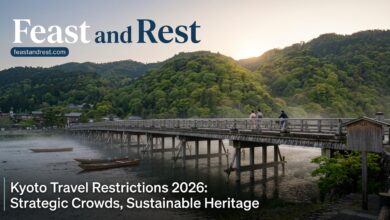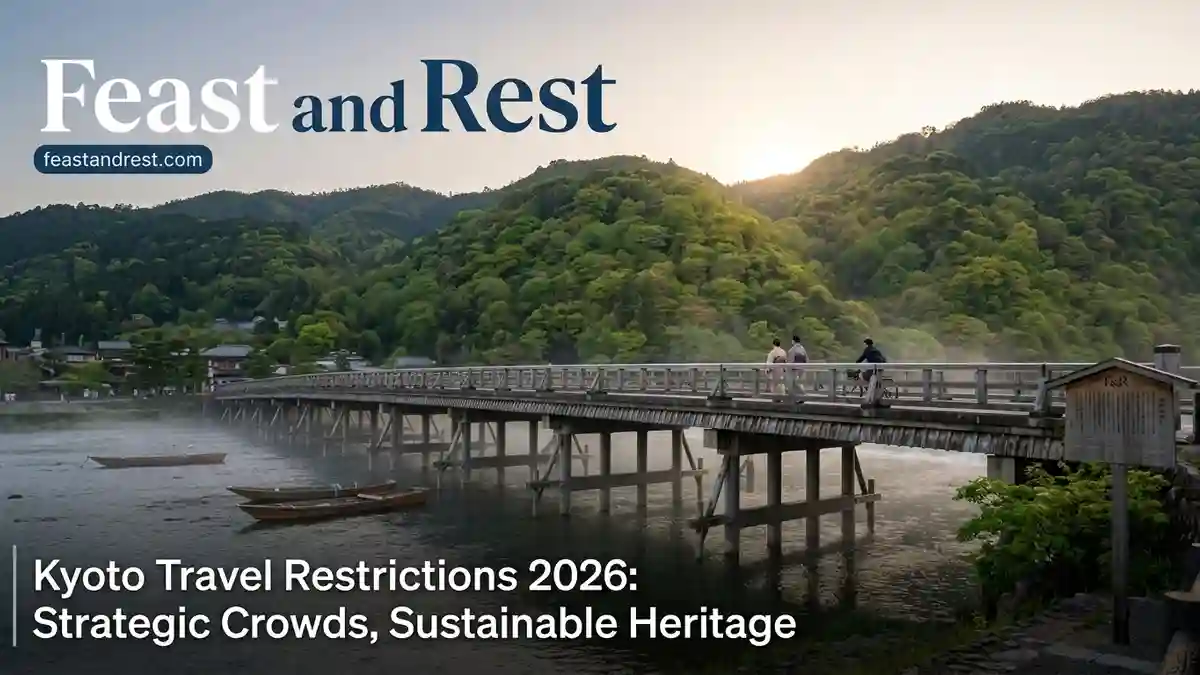
Managing High-Volume Tourism in Japan’s Cultural Capital
Kyoto travel restrictions 2026 reflect a comprehensive strategy by city officials and cultural preservation authorities to manage record-setting visitor volumes while protecting historical heritage. As Japan’s historic capital experiences unprecedented international arrivals, municipal policies have shifted from passive tourism promotion to strict crowd regulation, dynamic pricing models, and targeted transit controls. Understanding Kyoto travel restrictions 2026 requires examining how heritage site access, transportation regulations, and local ordinances intersect across high-volume corridors like Gion, Arashiyama, and Fushimi Inari.
The implementation of Kyoto travel restrictions 2026 directly addresses severe neighborhood congestion, public transit overload, and friction between residents and international visitors. For independent travelers and heritage enthusiasts, these updates alter traditional sightseeing routines, requiring early-morning arrivals, advance transit planning, and strict adherence to localized behavior mandates.
Kyoto Travel Restrictions 2026 Definition: An integrated network of municipal ordinances, transit bans, tiered tax structures, and site-specific crowd control protocols implemented by Kyoto City and the Japan Tourism Agency to mitigate overtourism, fund heritage conservation, and preserve resident livability.
Primary regulatory shifts impact five major sectors across the city:
Private Alley Access & Photography: Enforceable bans and ¥10,000 fines on designated private streets (shido) throughout the Gion historic district.
Public Transit Luggage Bans: Restrictions prohibiting oversized luggage on city buses, supported by dedicated “Hands-Free” luggage transfer infrastructure.
Accommodation Tax Restructuring: A progressive tax framework effective March 2026, increasing municipal levies on mid-range and luxury lodging.
Express Sightseeing Buses: Introduction of dedicated tourist express routes (EX Bus) connecting Kyoto Station directly to major landmarks to relieve neighborhood routes.
Dynamic Access & Early Morning Protocols: Strict congestion management advisories and staggered entry strategies at sites like Fushimi Inari Taisha and the Arashiyama Bamboo Grove.
Key Facts & Municipal Metrics
Within the broader landscape of Japan travel news, municipal data highlights the operational shift occurring across Kyoto’s historic core. Authorities including the Kyoto City Tourism Association (KCTA), the Japan National Tourism Organization (JNTO), and UNESCO monitoring bodies have established clear benchmarks for cultural protection.
| Operational Metric | Regulatory Details & Standard Policies | Strategic Objective |
| Gion Private Alley Fine | ¥10,000 penalty for non-resident entry on private roads (shido) | Protection of geiko and maiko privacy; resident livability |
| Public Bus Luggage Limit | Bulky luggage prohibited on standard municipal buses | Easing commuter transit bottlenecks |
| Accommodation Tax | Tiered rate per night (Revised March 1, 2026) | Funding historic preservation and crowd mitigation infrastructure |
| Fushimi Inari Access | 24-hour open precinct; peak density 09:00–16:00 | Early-morning dispersal of hiking crowds |
| Tourist Express Bus Fare | ¥500 flat fare for dedicated express transit lines | Separating tourist streams from residential daily commutes |
Key entities overseeing these directives include the Ministry of Land, Infrastructure, Transport and Tourism (MLIT), Kyoto Municipal Transportation Bureau, Agency for Cultural Affairs, and international heritage monitoring groups.
Fushimi Inari Early Morning Rules and Capacity Protocols
Fushimi Inari Taisha remains one of Japan’s most frequented Shinto shrines, drawing millions of visitors annually to its 10,000 vermilion torii gates along Mount Inari. While entry to the shrine precinct remains free and physically open 24 hours a day, managing visitor flow has necessitated new operational strategies.
Fushimi Inari Daily Visitor Density & Operational Windows:

05:00 - 07:30 [Optimal Window: Minimal Crowds / Soft Light]
08:00 - 09:30 [Moderate Density / Tour Groups Begin Arriving]
10:00 - 16:00 [Peak Congestion / Trail Bottlenecks / High Heat]
17:00 - 20:00 [Subsided Crowds / Lantern-Lit Lower Precinct]
Although no formal reservation pass or mandatory entry fee has been enacted for the public trail, authorities and local guide associations strongly emphasize Fushimi Inari early morning rules as an essential voluntary compliance standard. Visitors arriving between 05:00 and 07:30 experience unobstructed access through the Senbon Torii paths, avoiding the severe bottlenecks that develop by mid-morning.
       +-------------------------------------------------------+
       |   Fushimi Inari Early Morning Visitation Protocol    |
       +-------------------------------------------------------+
                                   |
                                   v
             +-------------------------------------------+
             | Depart Kyoto Station via JR Nara Line     |
             | (All trains stop at Inari Station)        |
             +-------------------------------------------+
                                   |
                                   v
             +-------------------------------------------+
             | Arrive Shrine Precinct (05:30 - 07:00)   |
             | Access Romon Gate & Main Shrine Hall      |
             +-------------------------------------------+
                                   |
                                   v
             +-------------------------------------------+
             | Ascend Senbon Torii to Yotsutsuji Inter.  |
             | Maintain quiet behavior near residential  |
             | edge zones                                |
             +-------------------------------------------+
Travelers utilizing the JR Nara Line benefit from updated rail schedules where rapid trains stop directly at Inari Station during morning operations, facilitating smooth connections from central Kyoto.
Managing Arashiyama Crowds and Transport Adjustments
The Western district of Arashiyama faces intense seasonal congestion, particularly within the Sagano Bamboo Grove and around Togetsukyo Bridge. Recent Japan tourism updates highlight specific transport adjustments aimed at mitigating bottlenecking along narrow rural roads.
To manage Arashiyama crowds, Kyoto City has introduced targeted measures:
Bus Rerouting and Restrictions: Large commercial tour buses face restricted drop-off windows near Togetsukyo Bridge during peak spring and autumn seasons.
Luggage Mitigation: Visitors arriving via the Keifuku Randen Line or JR San-in Main Line are directed to use station locker facilities or citywide luggage transfer services. Bringing large suitcases onto city buses servicing Arashiyama is heavily discouraged and frequently restricted by drivers.
Pedestrian Flow Control: Unidirectional walking lanes are enforced during peak congestion days along the main bamboo forest path leading to Okochi Sanso Villa.
       +-------------------------------------------------------+
       |       Arashiyama District Access Optimization        |
       +-------------------------------------------------------+
                                   |
                                   v
             +-------------------------------------------+
             | Primary Access Routes:                    |
             | • JR Sagano Line to Saga-Arashiyama       |
             | • Hankyu Railway to Arashiyama Station    |
             | • Randen Tramway to Arashiyama Center     |
             +-------------------------------------------+
                                   |
                                   v
             +-------------------------------------------+
             | Congestion Warning:                       |
             | Avoid City Bus routes #28 & #11 during    |
             | peak hours due to road gridlock           |
             +-------------------------------------------+
What the Data Shows: Tourism Density & Regional Impact
Statistical tracking by municipal agencies reveals a clear concentration of tourist activity within key zones. Data from the Kyoto City Tourism Association underlines the necessity of Kyoto crowd control initiatives.
Percentage of Daily Visitors Concentrated in Top 4 Districts:
[==================================================] 68%
(Gion/Higashiyama, Fushimi Inari, Arashiyama, Kinkaku-ji)

Percentage Distributing to Secondary Heritage Zones:
[==================] 32%
(Ohara, Takao, Yamashina, Fushimi Sake District, Uji)
These distribution metrics explain why the city implemented dynamic tools such as the AI-powered “Tourist Comfort Map”. This digital platform provides real-time congestion forecasts across major districts, enabling visitors to check crowd density before traveling.
Subheading analysis of Kyoto crowd control mechanisms demonstrates that congestion peaks consistently between 10:00 and 15:00. Shifting visitation outside these core hours reduces overcrowding at primary shrines while significantly improving transit efficiency.
Kyoto Temple Fees and Revenue Realignment
Financing the maintenance of UNESCO World Heritage sites requires substantial capital. Historic structures face wear and tear from millions of annual footsteps, prompting updates to entry pricing structures and tax collection models across the city.
While basic entry policies vary by site, changes in Kyoto temple fees and municipal taxes directly support site preservation:
Revised Accommodation Taxes: Effective March 1, 2026, Kyoto’s progressive accommodation tax collects higher rates on luxury hotel stays, directing funds toward municipal infrastructure, multilingual signage, and historic street paving.
Special Night Opening Admissions: Major temples including Kiyomizu-dera, Kodai-ji, and Eikan-do set separate admission fees (typically ¥600–¥1,000) for seasonal evening illuminations, managing crowd capacity through timed ticketing.
Preservation Contributions: Additional voluntary or bundled contributions at select heritage gardens directly support ongoing timber restoration and garden conservation.
These fiscal measures ensure that high visitor volume contributes directly to sustaining the city’s physical and cultural assets.
Societal and Sustainability Impact
The enforcement of Kyoto travel restrictions 2026 carries major implications for neighborhood preservation and resident well-being. Years of unrestrained visitor growth created significant friction in historic residential areas like Gion, where narrow alleys experienced noise disturbances, trash accumulation, and privacy violations.
By establishing strict behavioral guidelines—such as banning photography on private alleys, restricting large luggage on public buses, and incentivizing early-morning visits—Kyoto aims to rebalance tourism with daily municipal life. Sustainable tourism policies prioritize:
Cultural Respect (Manner) Enforcement: Clear multilingual signage detailing proper behavior at Shinto shrines and Buddhist temples.
Transit Relief: Dedicated tourist express buses (S-BUS) reducing overcrowding on neighborhood commuter routes.
Economic Equity: Utilizing lodging tax revenues to enhance municipal services and preserve historic machiya townhouses.
Comparative Analysis: Heritage Management Strategies
Kyoto’s approach to overtourism reflects broader global strategies implemented across high-density heritage destinations.
| Destination | Core Challenge | Regulatory Strategy | Key Outcome |
| Kyoto, Japan | Neighborhood crowding, transit bottlenecks, private alley trespassing | Alley entry fines, transit luggage bans, progressive lodging tax | Reduced transit friction; enhanced privacy in historic quarters |
| Venice, Italy | Day-tripper saturation, narrow canal congestion | Day-visitor entry fees (Contributo di Accesso), cruise ship bans | Financial contribution from day visitors; reduced lagoon disruption |
| Amsterdam, Netherlands | Center district congestion, noise, behavioral issues | Center hotel bans, guided group size limits, targeted etiquette campaigns | Reduced street congestion in core historical center |
Kyoto’s strategy emphasizes behavioral regulation and transit management rather than imposing strict citywide entry quotas, preserving open access while channeling crowd distribution.
Strategic Planning for Cultural Travelers
Navigating Kyoto travel restrictions 2026 successfully requires practical adjustments to traditional travel itineraries. Travelers can optimize their experience while supporting sustainable local tourism by adopting strategic planning measures:
Utilize Early Morning Windows: Plan visits to high-demand sites like Fushimi Inari Taisha and Arashiyama Bamboo Grove before 07:30.
Leverage Hands-Free Travel: Forward large luggage from arrival hubs (such as Kansai International Airport or Kyoto Station) directly to accommodations using official baggage delivery services.
Adopt Express Transit Options: Use the Tourist Express Bus (S-BUS) or direct rail lines rather than local residential bus routes when connecting major sightseeing hubs.
Monitor Real-Time Congestion Data: Consult the Kyoto City Tourism Association’s digital forecast tools to adjust plans based on live crowd density readings.
Adhering to local rules and adapting travel habits ensures a high-quality cultural experience while helping safeguard Kyoto’s irreplaceable living heritage.
Stay inspired with Feast and Rest!
Source and Data Limitations
This analytical destination report compiles official municipal announcements, regional transit updates, and published regulations from the Kyoto City Tourism Association (KCTA), the Japan National Tourism Organization (JNTO), the Japan Ministry of Land, Infrastructure, Transport and Tourism (MLIT), and local heritage preservation councils through mid-2026. Factual references regarding accommodation tax structures, Gion private street restrictions, and public bus baggage rules reflect official policy frameworks established by Kyoto Municipal authorities.
Unverified travel blog claims, speculative future ticket price increases, and unconfirmed sanctuary closures were excluded from this article. Operational schedules, express bus fares, and specific access rules remain subject to adjustment by municipal transport bureaus and shrine administrative offices based on seasonal congestion demands and weather events. Travelers are advised to verify real-time transit alerts and local congestion maps via official municipal portals prior to departure.