A Strategic New Addition to Beijing’s Luxury Landscape
The November 2026 debut of JW Marriott Beijing Dongzhimen marks a notable milestone for both the neighborhood and Marriott International. Positioned directly above one of the Chinese capital’s busiest transit interchanges in Dongcheng District, the property opens as Beijing’s third JW Marriott and Marriott International’s 800th hotel in Greater China. For international travelers arriving from North America, Europe, the Middle East, or neighboring Asian hubs, the opening introduces a full-service luxury option in a part of the city long prized for its logistical convenience rather than high-end hotel inventory.
Rather than functioning purely as a corporate transit stop, the 413-room hotel is designed as an elevated urban retreat. Its positioning bridges two distinct sides of Beijing: the modern diplomatic and commercial corridors to the east, and the historic, residential hutong alleys to the west. Whether visiting for diplomatic meetings, multi-stop regional business, or cultural sightseeing, guests gain an immediate foothold in central Beijing without sacrificing residential quietude.
Location and Connectivity at Dongzhimen
Few addresses in Beijing offer the sheer transit utility of No. 7 Dongzhimenwai Xiejie. Dongzhimen has served as an eastern gateway to the inner city for centuries, and today it operates as a primary multi-modal transport hub.
The property sits approximately 23 kilometers (about 14 miles) from Beijing Capital International Airport (PEK). Crucially for travelers looking to bypass Beijing’s notoriously unpredictable highway traffic, Dongzhimen is the city-side terminus for the Capital Airport Express train, alongside major subway lines (Lines 2 and 13) and regional bus links.
Beyond transit efficiency, the immediate surroundings offer a rich cross-section of daily Beijing life:
Cultural Landmarks: The Yonghe Temple (Lama Temple), Guozijian (Imperial Academy), and the historic Wudaoying Hutong are all within easy reach to the northwest.
Diplomatic and Commercial Zones: Beijing’s Second Embassy District and the business towers of Chaoyang District sit just across the Second Ring Road.
Shopping and Nightlife: Sanlitun Taikoo Li and Workers’ Stadium lie a short drive or one subway stop away, offering international retail and contemporary dining.
Local Culinary Streets: Guijie (Ghost Street), famous across Beijing for late-night Sichuan spicy crayfish and traditional northern dishes, is practically on the doorstep.
For travelers planning a 2026 or 2027 itinerary, this placement means you can realistically fit a morning walk around historic temple courtyards and an afternoon meeting near Sanlitun into the same schedule without spending hours in a taxi.
Courtyard-Inspired Design by Cheng Chung Design
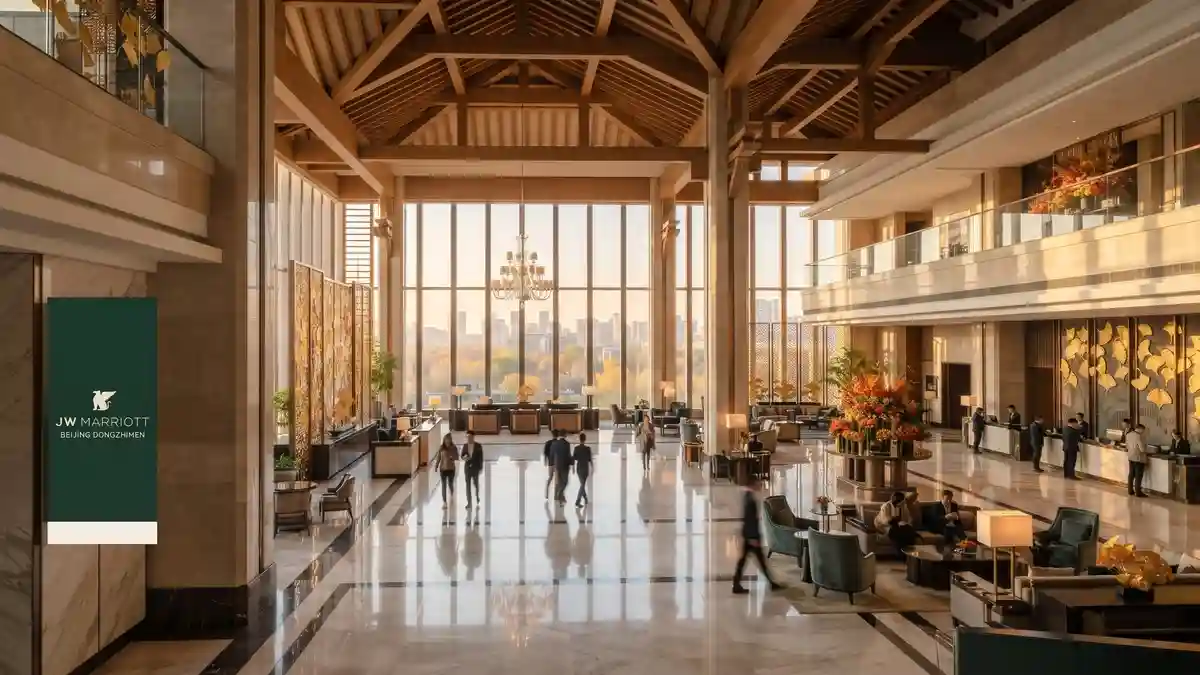
While the exterior rises above a bustling urban junction, the interior architecture intentionally slows the pace. Created by the acclaimed hospitality firm Cheng Chung Design (CCD), the spaces draw heavily from Beijing’s imperial palace architecture and traditional siheyuan (courtyard houses).
According to project details released at launch, CCD avoided heavy, overly ornate historical replicas in favor of cleaner, contemporary interpretations. In the lobby, a focal artwork titled Shadows Along the Palace Wall uses mother-of-pearl inlay to capture the subtle interplay of tree shadows falling across the gilded doors of the Forbidden City.
Throughout the public zones, warm timber tones, textured stone, and layered lighting echo the transition from public street to private courtyard. The color palette leans into the golden hues of Beijing in autumn, referencing the ginkgo trees that line the city’s older avenues each October and November. This design approach gives the property a grounded sense of place that distinguishes it from more generic glass-and-steel business towers nearby.
Rooms and Suites: Daylight and Practical Comfort
JW Marriott Beijing Dongzhimen features 413 guest rooms and suites, starting with 41-square-meter Deluxe Rooms and scaling up to a 205-square-meter Presidential Suite. Entry-level rooms at 41 square meters are generously proportioned by central Beijing standards, providing enough floor space to comfortably unpack two large suitcases without crowding the seating area.
Inside the accommodations, ginkgo-leaf decorative screens and soft neutral fabrics reinforce the calm aesthetic. One particularly thoughtful feature for long-haul international arrivals is the circadian-friendly lighting system, which adjusts to mirror natural daylight patterns—a subtle but practical asset when recovering from jet lag after a transpacific or European flight.
Standard in-room appointments reflect current upper-upscale and luxury expectations:
Sleep and Bath: 400-thread-count linens, deep soaking tubs paired with separate walk-in rain showers, smart toilets, and Aromatherapy Associates bath products.
Technology and Convenience: 65-inch LCD televisions, JAMO Bluetooth speakers, high-speed wired and wireless internet, Nespresso machines, and Dyson hair dryers.
Executive Access: High-floor Executive Rooms and suites include access to the 17th-floor Executive Lounge, which provides panoramic city views alongside daily breakfast, afternoon tea, and evening refreshments.
For families or extended-stay guests, booking a Studio or Junior Suite adds dedicated reception and work zones, making it easier to separate sleeping quarters from daytime work calls.
Five Dining Venues Anchored by Regional Chinese Cuisine
Hotel dining in Beijing faces fierce competition from the surrounding neighborhood, particularly with Guijie’s endless rows of casual eateries right outside. To give guests compelling reasons to dine on-site, JW Marriott Beijing Dongzhimen houses five distinct food and beverage concepts:
| Venue | Level | Culinary Focus | Key Highlights |
| Lu Shang Lu | Level 3 | Refined Shandong (Lu) Cuisine | Led by a culinary team with Michelin-starred kitchen pedigree; smart casual dress code. |
| JW Kitchen | Level 5 | International & Beijing Favorites | All-day dining with open kitchens, breakfast buffets, and weekday business lunches. |
| Villa Dongzhi | Level 5 | Charcoal Grill & Wine Bar | Glass conservatory setting with greenery, dry-aged steaks, wood-fired dishes, and a gin cart. |
| The Lounge | Level 1 | Afternoon Tea & Cocktails | Eastern-inspired social space with an outdoor courtyard terrace for daytime tea and evening drinks. |
| JW Market | Ground/Lobby | Grab-and-Go Gourmet | Artisanal pastries, specialty coffee, and light casual bites for travelers on tight schedules. |
The standout culinary draw is Lu Shang Lu on Level 3. Shandong cuisine—one of China’s Four Great Culinary Traditions and historically the foundation of Beijing’s imperial palace cooking—is less frequently showcased in international luxury hotels than Cantonese or Sichuan fare. Having a dedicated venue backed by a brand with Michelin-starred pedigree offers food-focused travelers an accessible way to experience delicate braises, seafood preparations, and classic northern techniques without navigating local reservation barriers.
Meanwhile, Villa Dongzhi pairs charcoal- and wood-fired cooking with a conservatory-style layout and a dedicated herb garden, creating an inviting atmosphere for relaxed evening meals.
Wellness Facilities and Event Spaces
True to the JW Marriott brand’s emphasis on mindful balance, the wellness floor is built to counteract the pace of central Beijing. Guests have access to a 25-meter naturally lit indoor swimming pool, a whirlpool, and a 24-hour fitness center outfitted with Technogym equipment and floor-to-ceiling windows.
For deeper recovery, the on-site Woo Spa features four treatment rooms set within a quiet, garden-inspired environment. While smaller in footprint than a sprawling resort spa, the intimate four-room setup keeps foot traffic low and appointments unhurried.
On the corporate and social front, the hotel offers more than 1,400 square meters of event space. This includes an 810-square-meter pillarless Grand Ballroom alongside an outdoor terrace and a semi-open venue equipped with a show kitchen—a versatile layout suited for diplomatic receptions, product launches, and private dinners.
Practical Planning Tips for Your Stay
Because JW Marriott Beijing Dongzhimen sits at the intersection of transit, business, and heritage districts, a few strategic choices can significantly improve your stay:
Who It Suits Best: The hotel is an ideal fit for business travelers with meetings in Chaoyang or the embassy belt, Marriott Bonvoy elite members seeking strong lounge and suite upgrade potential, and independent leisure travelers who want effortless subway access to major sights. Travelers seeking a quiet, low-rise courtyard boutique atmosphere directly inside a residential hutong may prefer smaller heritage properties further west.
Best Seasons to Visit: Autumn (late September through early November) is widely considered Beijing’s prime travel window, offering crisp air and golden ginkgo foliage that mirrors the hotel’s interior design theme. Spring (April to May) brings mild weather and blooming courtyard trees, though occasional windy days occur.
Smart Airport Transfers: If you are traveling with standard luggage from Beijing Capital International Airport (PEK), consider taking the Capital Airport Express train directly to Dongzhimen Station. During peak weekday rush hours (7:30–9:30 AM and 5:00–7:30 PM), the train frequently beats private car transfers by 20 to 30 minutes.
Dining Reservations: While JW Kitchen and The Lounge accommodate walk-ins easily, booking a table in advance for dinner at Lu Shang Lu is recommended, especially on Thursday through Saturday evenings.
Digital Readiness: Before arriving in China, ensure you have linked an international credit card to Alipay or WeChat Pay, and download an offline-capable translation app and local mapping tool (such as Amap or Apple Maps) for smooth navigation around Dongcheng District.
Stay sharp with Feast and Rest.