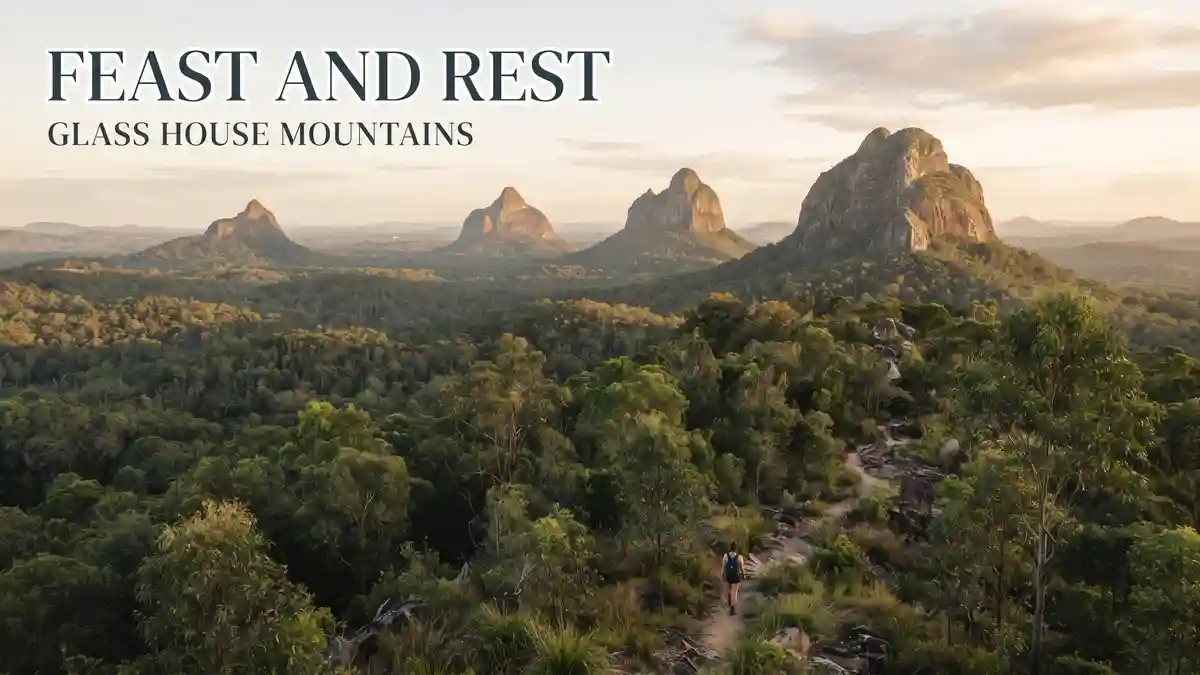
Glass House Mountains National Park protects a cluster of steep volcanic plugs rising dramatically above the coastal lowlands of South East Queensland, roughly 70 kilometers north of Brisbane near the Sunshine CoastClick to open side panel for more information. For cultural travelers, the park matters because it combines rare geological formations, living First Nations heritage of the Jinibara and Gubbi Gubbi peoples, and layered colonial history within an accessible day-trip distance. Rather than a conventional mountain range formed by tectonic folding, these peaks are eroded intrusive volcanic plugs left behind after softer surrounding rock wore away over millions of years. Glass House Mountains National Park 4.7 stars rating4.7 🏞️ National park Open · Closes 12:00 AM Tue Recognized across natural, Indigenous, and historic dimensions by the Australian Government Department of Climate Change, Energy, the Environment and Water (DCCEEW), the landscape was inscribed on Australia's National Heritage List in August 2006. Managed by the Queensland Department of the Environment, Tourism, Science and Innovation and Queensland Parks and Wildlife Service (QPWS) in coordination with Tourism and Events Queensland, Sunshine Coast Council, and Visit Sunshine Coast, the park sits alongside broader regional conservation corridors and cultural heritage sites such as nearby bora grounds and art and literary works inspired by poets and artists including Judith Wright and David Malouf. Why This Matters: Geological Craft and Living First Nations Heritage Visitors arriving in South East Queensland often treat the skyline as a scenic backdrop on the way to coastal resorts, yet the peaks represent one of Australia's clearest examples of an eroded central volcano complex. Formed roughly 24 to 27 million years ago as magma cooled inside volcanic vents and surrounding sandstone and softer strata eroded, the remaining domes, spires, and columns rise abruptly from open eucalypt forest and coastal heath. Equally central to understanding the destination is its deep cultural meaning for Traditional Owners, the Jinibara people and the Gubbi Gubbi people. Oral histories and cultural traditions link individual peaks—such as Mount BeerwahClick to open side panel for more information and TibrogarganClick to open side panel for more information—to ancestral relationships, seasonal pathways, and gathering areas, while recorded cultural sites in the broader landscape include stone quarries, axe-grinding grooves, and ceremonial places. As Queensland Parks and Wildlife Service notes in its visitor guidance: "The Glass House Mountains are not easy climbs and it is important to be prepared so that you can have a safe and enjoyable visit." Respecting cultural protocol means recognizing that some knowledge is not for public sharing, staying strictly on marked tracks, and honoring safety and access rules rather than treating sacred peaks as recreational stunt terrain. What the Data Shows: Access Rules, Risk Management, and Planning Metrics Official management records from Queensland Parks and Wildlife Service highlight a sharp contrast between easy scenic viewing and high-consequence rock terrain. While entry to the national park is free, camping is not permitted inside the park, dogs are prohibited, and rubbish bins are absent on trails so visitors must carry all waste out. Safety and conservation data also shape how cultural travelers plan an itinerary. Since March 1999, the Mount Coonowrin section of Glass House Mountains National Park has been declared a Restricted Access Area under Queensland nature conservation legislation due to unstable rock and high to very high rockfall risk, with on-the-spot fines and higher court penalties applying to unauthorized entry. In addition, the microscopic plant pathogen Phytophthora cinnamomi (Phytophthora dieback) threatens native flora, prompting strict footwear- and gear-cleaning practices at trailheads. Planning Dimension Key Verified Fact or Pattern Practical Travel Takeaway Park Admission & Camping Free entry; no camping inside the national park; no dogs; carry-in/carry-out waste Plan day trips or base in nearby Sunshine Coast or hinterland towns Highest Peak & Elevation Mount Beerwah reaches 556 meters above sea level Visible from lookout points; requires careful assessment of safety and cultural guidance Restricted Access Zones Mount Coonowrin closed to public access since March 1999 due to rockfall hazard View from lawful public vantage points; never approach cliff base or enter closed zones Biosecurity & Trail Care Phytophthora dieback spreads via soil on footwear and equipment Clean boots and poles before entering and leaving tracks; stay on marked routes Seasonal & Daily Timing Warm subtropical climate; cooler mornings offer active birdlife and gentler temperatures Start early in the day, carry water, and check live Queensland Parks alerts before departure Comparing Glass House Mountains National Park With Similar Australian Landscapes Travelers weighing Glass House Mountains National Park against other iconic Australian parks benefit from clear distinctions in topography and trip structure. Unlike coastal headland walks such as Noosa National Park further north on the Sunshine Coast or expansive Gondwana rainforest plateaus in Lamington National Park and Springbrook National Park, this park centers on isolated volcanic plugs rising from lowland forests. Compared with multi-day wilderness parks or vast sand-island reserves like K'gari (Great Sandy), Glass House Mountains National Park functions primarily as a half-day or full-day excursion roughly an hour north of Brisbane. A well-paced itinerary pairs a morning walk or scenic stop—such as the Tibrogargan circuitClick to open side panel for more information or the Glass House Mountains LookoutClick to open side panel for more information day-use area—with time in hinterland communities or coastal towns rather than attempting to stack multiple distant parks in a single day. Sustainability, Community Impact, and Heritage Preservation Tourism around Glass House Mountains National Park supports hospitality and service businesses across the Sunshine Coast and hinterland while creating ongoing management pressures on fragile ecosystems and peri-urban neighborhoods. Because the national park consists of separate parcels bordering rural-residential land, forestry areas, and transport corridors, erosion control, wildfire and prescribed-burn coordination, and pest management require ongoing collaboration among state agencies, local councils, and community groups. Sustainable destination planning in this landscape relies on low-impact habits that protect both biodiversity and cultural integrity. Travelers contribute to heritage access and conservation by using footwear-cleaning stations, avoiding rock or plant collection, respecting track closures, and supporting local operators who interpret natural and cultural history accurately. Practical Destination Planning for Cultural Travelers Successful destination planning around Glass House Mountains National Park starts with checking current conditions, weather, and track status on official Queensland Parks advisories shortly before travel. Because routes range from short lookout strolls to steep, demanding scrambles, matching route selection to fitness, footwear, and weather conditions prevents preventable rescues and delays. Seasonal travel considerations also shape comfort and logistics across the year. Cooler, drier months generally provide clearer visibility and more comfortable walking conditions than hot, humid summer afternoons when dark volcanic rock radiates heat. Arriving early in the morning helps travelers avoid peak midday warmth, find parking at popular trailheads, and experience birdlife and forest habitats at a measured pace. Stay inspired with Feast and Rest! — Source and Data Limitations This article draws on official Australian and Queensland government sources, including the Australian Government Department of Climate Change, Energy, the Environment and Water (National Heritage List record for the Glass House Mountains National Landscape, updated April 2026), the Queensland Department of the Environment, Tourism, Science and Innovation and Queensland Parks and Wildlife Service (park overview, Mount Coonowrin restricted access information reviewed September 2026, and the 2013 Glass House Mountains National Park Management Statement), and regional tourism resources from Visit Sunshine Coast. Australian Bureau of Statistics 2021 Census data was reviewed for local suburb demographic context where relevant. Specific current-year annual visitor headcounts for the national park were not publicly itemized in the retrieved official park notices, so visitor volume is discussed qualitatively alongside verified operational rules and heritage milestones. Unverified commercial claims and speculative route advice were excluded in favor of official conservation and safety guidance.
 Rohis Uddin
Follow on X
4 hours ago
Follow on X
Rohis Uddin
Follow on X
4 hours ago
 Rohis Uddin
Follow on X
4 hours ago