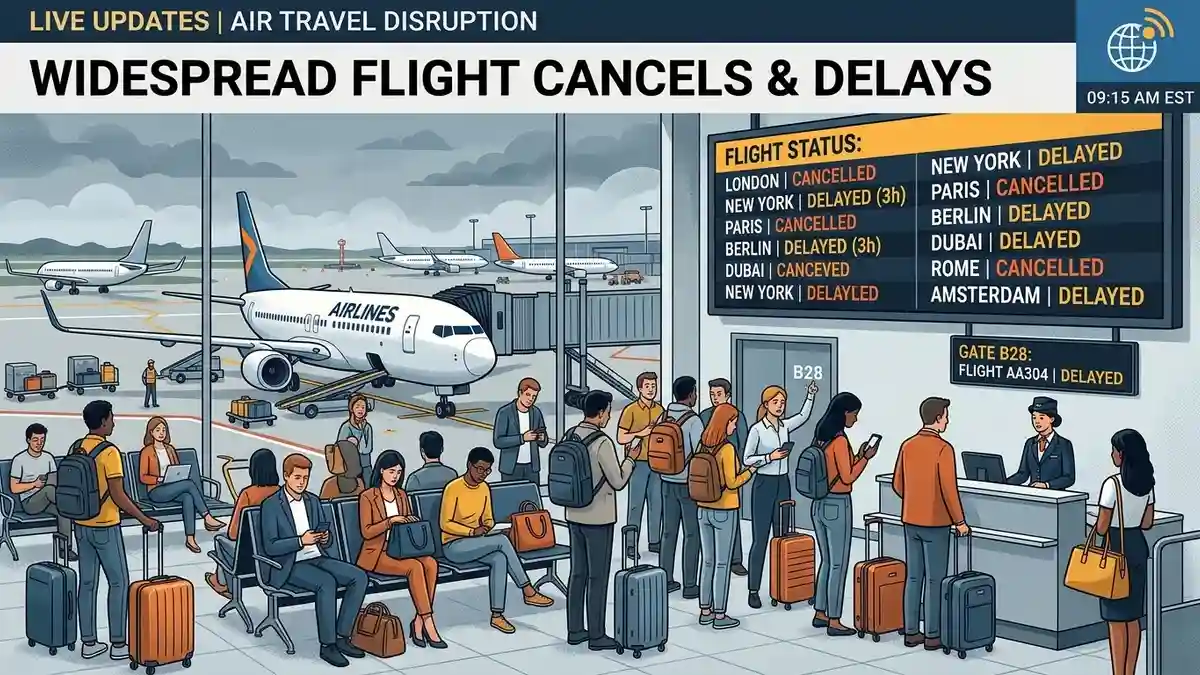
Understanding FAA ground stop flight refund rules is essential for cultural travelers navigating sudden airspace closures, as federal consumer protections guarantee full cash refunds for canceled itineraries regardless of the underlying technical cause. Following the November 13, 2026, nationwide air traffic control communications outage—which halted all US departures for over four hours and disrupted nearly 7,000 flights—passengers across North America and Europe faced cascading schedule adjustments. Monitoring a real-time US air travel disruption tracker alongside carrier waivers allows travelers to pivot smoothly between securing JFK and O’Hare flight delay compensation, booking the best airport hotels near Chicago O’Hare, or learning how to rebook canceled American Airlines flights. Equally important for international itineraries is knowing how travel insurance for air traffic control delays interacts with UK to US flight suspension updates and Montreal to US flight cancellations.
Featured Snippet Definition: FAA Ground Stop Flight Refund Rules
Under U.S. Department of Transportation (DOT) regulations, if an airline cancels a flight or institutes a significant schedule change (3 or more hours domestically; 6 or more hours internationally) due to a Federal Aviation Administration (FAA) ground stop, passengers who choose not to travel are legally entitled to a full cash refund to their original payment method—including on nonrefundable tickets—within 7 business days for credit card purchases.
The November 2026 airspace freeze marks only the third nationwide departure halt in modern aviation history, following September 11, 2001, and a brief computer system outage in January 2023. According to data from the Federal Aviation Administration, more than 14,000 air traffic controllers manage over 44,000 daily flights across the United States. When an Air Route Traffic Control Center communications failure occurs, safety protocols prioritized by Transportation Secretary Sean Duffy, Eurocontrol, Aéroports de Montréal, and international flag carriers like Virgin Atlantic and Aer Lingus require immediate ground holds that ripple across global heritage corridors for days.
Why This Matters: FAA Ground Stop Flight Refund Rules and Passenger Rights
For travelers exploring historic cities, museums, and UNESCO World Heritage sites across North America, an unexpected airspace closure threatens tightly coordinated itineraries. Knowing the legal distinction between a federal ground hold and an airline cancellation protects travelers from inadvertently forfeiting their ticket value.
Under U.S. Department of Transportation (DOT) enforcement rules, an FAA ground stop alone does not automatically render an active ticket refundable. Instead, FAA ground stop flight refund rules trigger once the operating carrier officially cancels the flight or delays departure by at least three hours on domestic routes or six hours on international routes. Travelers holding nonrefundable fares should never proactively cancel their own reservations before the airline issues a formal cancellation notice or travel waiver, as voluntary cancellations before carrier action may limit recovery to future flight credits.
“According to the U.S. Department of Transportation, if an airline cancels your flight and you choose not to travel, you’re entitled to a refund — regardless of what caused the cancellation. That includes nonrefundable tickets.“
— U.S. Department of Transportation Consumer Guidance (via KPRC / Click2Houston, November 2026)
Key Facts: Federal Refund Timelines
Credit Card Purchases: Refunds must be processed back to the original card within 7 business days.
Cash, Check, or Debit Purchases: Refunds must be issued within 20 calendar days.
Loyalty Points and Miles: Redeemed miles must be redeposited into the traveler’s frequent flyer account alongside a cash refund of government taxes and carrier-imposed fees.
Voucher Protections: Passengers are never obligated to accept travel vouchers or flight credits when eligible for a statutory cash refund.
What the Data Shows: US Air Travel Disruption Tracker and Cross-Border Ripple Effects
Real-time aviation telemetry illustrates how rapidly a four-hour domestic airspace freeze impacts international cultural gateways. During the November 13, 2026, outage—which began at 3:54 p.m. EST and lasted until airspace reopened at 8:15 p.m. EST—aviation tracking platform FlightAware recorded nearly 7,000 delayed or canceled US flights.
Because aircraft and flight crews were stranded out of position overnight, secondary disruptions persisted throughout Saturday, November 14. Cross-border and transatlantic corridors connecting major cultural hubs experienced immediate knock-on effects, with Montreal to US flight cancellations and UK to US flight suspension updates reshaping weekend arrivals at major East Coast and Midwest gateways.
| Corridor / Hub | Recorded Operational Impact (Nov 13–14, 2026) | Primary Operational Bottleneck |
| US National Airspace | Nearly 7,000 flights delayed or canceled across 44,000+ daily operations | Air Route Traffic Control Center communications failure |
| Montreal-Trudeau (YUL) to US | All US flights halted Friday (61 cancellations); 40 additional cancellations Saturday | Out-of-position aircraft unable to operate inbound legs |
| UK & Europe (Eurocontrol) to US | Departures from 42 Eurocontrol member states suspended 22:00 UTC Nov 13 to 05:00 UTC Nov 14 | Transatlantic flow-control restrictions requested by the FAA |
| New York JFK & Chicago ORD | Multi-hour departure holds and rolling regional cancellations (e.g., AA3113, AA3162) | Gate congestion and crew duty-time resets across hub networks |
“Aircraft that were unable to land in Montreal yesterday cannot depart today, which explains these cancellations. We encourage travelers to check the status of their flight with their airline before heading to the airport.”
— Aéroports de Montréal (Montreal-Trudeau International Airport) Spokesperson (via CTV News, November 14, 2026)
In the United Kingdom, London Heathrow and Manchester Airport advised travelers to monitor carrier channels closely as transatlantic rotations stabilized. Virgin Atlantic canceled select New York JFK–London Heathrow rotations (including VS25 and VS26), while Aer Lingus noted that airborne flights en route to the United States were permitted to land on a case-by-case basis.
Navigating JFK and O’Hare Flight Delay Compensation and Rebooking
Major metropolitan gateways like New York’s John F. Kennedy International Airport (JFK) and Chicago O’Hare International Airport (ORD) serve as primary entry points for travelers visiting architectural landmarks, performing arts districts, and national museums. When air traffic control outages disrupt these hubs, JFK and O’Hare flight delay compensation follows strict regulatory boundaries.
Because air traffic control communications failures fall outside an airline’s direct operational control, US carriers are not legally required by federal statute to provide complimentary hotel rooms, meal vouchers, or ground transportation. This contrasts with controllable disruptions—such as mechanical issues or crew shortages—where major US airlines commit to providing meals and overnight lodging under DOT customer service dashboards.
However, travelers flying from the United Kingdom or European Union into JFK or O’Hare benefit from overlapping international frameworks (UK261 / EU261). While extraordinary circumstances like air traffic control closures generally exempt carriers from paying fixed cash delay compensation under UK261/EU261, airlines operating flights departing from UK or EU airports remain legally obligated to provide “duty of care”—including meals, refreshments, and overnight hotel accommodations—during extended delays regardless of the cause.
How to Rebook Canceled American Airlines Flights
For passengers transiting through major hubs such as Chicago O’Hare or New York JFK, knowing how to rebook canceled American Airlines flights efficiently minimizes lost sightseeing time. During the November 2026 ground stop, American Airlines issued a system-wide travel alert for tickets purchased on or before November 12 for travel on November 13 or 14, waiving change fees and fare differences within the same cabin for travel rescheduled through November 17.
Use Self-Service Digital Tools First: Open the American Airlines mobile app or website immediately upon receiving a cancellation alert to select alternative flights without waiting in terminal queues.
Verify Travel Waiver Eligibility: Confirm that your rebooked itinerary falls within the carrier’s specified travel window (changes completed by November 14 for travel through November 17) so fare differences remain waived.
Request Interline or Partner Routing: If direct flights between hubs like JFK and ORD are fully booked, ask a gate agent or airport Customer Service Center representative about routing through secondary hubs (such as Charlotte, Dallas/Fort Worth, or Philadelphia).
Document All Disruption Notices: Screenshot original itineraries, cancellation timestamps, and rebooking confirmations to support any subsequent refund or insurance claims.
Practical Transit Planning: Best Airport Hotels Near Chicago O’Hare
When an airspace closure strands travelers overnight in the Midwest, securing lodging quickly is critical before inventory sells out across the Rosemont and Schiller Park corridor. Identifying the best airport hotels near Chicago O’Hare ensures effortless access to early-morning recovery flights while offering proximity to Chicago’s cultural institutions via the CTA Blue Line rapid transit system.
Because airlines rarely cover lodging during air traffic control ground stops, travelers paying out of pocket—or utilizing trip delay insurance—should balance terminal proximity against seasonal room rates. During autumn and winter transit disruptions, standard nightly rates near O’Hare typically range from $180 to $330 depending on direct terminal connectivity and shuttle frequency.
Hilton Chicago O’Hare Airport (On-Property): Located directly across from Terminals 1, 2, and 3 and connected via underground pedestrian walkways, this property eliminates shuttle wait times during severe weather or mass flight cancellations, with rates averaging around $330 per night.
Loews Chicago O’Hare Hotel (Rosemont): Situated roughly 1.7 miles from the terminals with complimentary 24-hour shuttle service, this upscale option sits adjacent to the Parkway Bank Park entertainment district and Rosemont CTA Blue Line station for 40-minute direct train access to downtown Chicago’s Art Institute and Millennium Park.
Hyatt Regency O’Hare Chicago (Rosemont): Located 1.8 miles from the airport with frequent shuttle transfers and a covered walkway to the Rosemont CTA station, offering spacious atrium accommodations suited for families and longer layovers.
Sheraton Suites Chicago O’Hare (Rosemont): Positioned 1.7 miles from the airfield with dedicated airport shuttle service, providing two-room suites that allow stranded travelers to work or rest comfortably while awaiting rebooked departures.
Hampton Inn Chicago-O’Hare International Airport (Schiller Park): A practical value-oriented property roughly two miles from the terminals offering complimentary breakfast and airport shuttle transfers for budget-conscious travelers.
Financial Protection: Travel Insurance for Air Traffic Control Delays
Because federal FAA ground stop flight refund rules only cover the cost of unused airfare—leaving stranded passengers responsible for meals, hotels, and missed destination bookings—travel insurance for air traffic control delays serves as an essential financial buffer.
Comprehensive travel insurance policies and premium travel credit cards typically include “Trip Delay” and “Trip Interruption” coverage that explicitly cover common carrier delays caused by air traffic control restrictions or equipment failures.
By the Numbers: Trip Delay Insurance Thresholds
6 to 12 Hours: Standard waiting period required before trip delay reimbursement activates on most standalone policies and premium travel credit cards.
$500 per Ticket: Typical maximum reimbursement cap per covered trip for reasonable out-of-pocket expenses, including overnight lodging, meals, local taxi transfers, and essential toiletries.
72 Hours: Standard notification window required by major insurers such as Allianz Travel Insurance to report a trip interruption or missed tour/cruise connection.
To validate a claim following an FAA ground stop, insurers require itemized receipts for every expense alongside a formal “Statement of Delay” or cancellation verification letter from the airline confirming that air traffic control caused the disruption. Travelers with prepaid, nonrefundable museum passes, heritage rail tickets, or hotel nights at their final destination should also review their policy’s Trip Interruption section, which can reimburse forfeited prepaid arrangements when a common carrier delay causes a missed arrival.
Destination Resilience and Cultural Tourism Impact
Large-scale aviation disruptions highlight the broader relationship between transportation infrastructure, local hospitality communities, and sustainable cultural tourism. When thousands of travelers are unexpectedly grounded at major hubs like New York, Chicago, London, or Montreal, airport-adjacent municipalities absorb sudden surges in demand for lodging, dining, and local transit.
For surrounding communities such as Rosemont, Illinois, or Queens, New York, hospitality workers, shuttle operators, and transit staff play a vital frontline role in supporting stranded visitors. At the same time, sudden flight cancellations ripple outward to cultural destinations—causing abrupt occupancy drops at heritage hotels, delayed arrivals for guided museum tours, and scheduling pressures on small local tour operators.
Sustainable and Resilient Destination Planning Tips
Build Buffer Days Into Cultural Itineraries: When traveling across international borders to visit time-sensitive festivals, UNESCO sites, or multi-day heritage tours, schedule arrival at least 24 hours prior to nonrefundable activities.
Prioritize Rail-Connected Airport Hubs: Selecting airports with direct public transit links—such as Chicago O’Hare’s CTA Blue Line, New York JFK’s AirTrain to the LIRR and Subway, or London Heathrow’s Elizabeth Line—reduces reliance on congested airport roadways and lowers ground transit emissions during mass disruptions.
Support Local Small Businesses During Layovers: Rather than remaining confined to terminal concourses during extended 12-to-24-hour rebooking windows, travelers can use direct transit connections to explore neighborhood dining, local historic districts, and community museums responsibly.
“Before clearing flights to resume, we thoroughly tested our systems to confirm they were stable and that operations remain reliable. Passengers should contact their airlines for flight updates.”
— Federal Aviation Administration (FAA) Official Statement (November 14, 2026)
By combining knowledge of FAA ground stop flight refund rules with proactive travel insurance and flexible transit planning, travelers can navigate unexpected airspace disruptions calmly while protecting both their travel budgets and their cultural itineraries.
Stay inspired with Feast and Rest!
—
Source and Data LimitationsThis article is based on verified reports, regulatory guidelines, and operational updates published through November 14, 2026. Primary sources include official statements and consumer protection rules from the U.S. Department of Transportation (DOT), Federal Aviation Administration (FAA) operational advisories, Eurocontrol Network Manager Operations Centre (NMOC) notices, Aéroports de Montréal (Montreal-Trudeau International Airport) spokespeople, Virgin Atlantic and Aer Lingus travel alerts, FlightAware real-time disruption data, and published trip delay policy guidelines from Allianz Travel Insurance and the National Association of Insurance Commissioners (NAIC). Airport hotel proximity and baseline pricing metrics reflect publicly listed property data for Chicago O’Hare International Airport (ORD) as of November 2026. Limitations: Because post-ground-stop airline recovery schedules and individual carrier travel waivers evolve rapidly, exact cancellation tallies and waiver expiration dates beyond November 17–21, 2026, remain subject to carrier updates. Speculative reports regarding the underlying technical root cause of the FAA communications outage have been excluded pending final federal investigation findings.