The evolution of Singapore’s luxury hospitality scene has shifted from traditional grand hotels to highly curated, design-driven spaces. As global travelers seek unique identities rather than standardized luxury, the upcoming debut of NoMad on Orchard Road marks a notable development in the region. Managed under a partnership following Hilton’s acquisition of a majority stake in Sydell Group, this upcoming property represents a major expansion of luxury lifestyle accommodations APAC. This early NoMad Hilton Singapore review examines how the brand’s signature atmospheric New York style adapts to a biophilic Southeast Asian setting, offering a fresh option among the best boutique hotels Singapore has to offer.
Positioned on the former site of Faber House at 230 Orchard Road, the 19-story development is scheduled to open in late 2026 or early 2027. Developed by UOL Group Limited, the hotel moves away from the massive scale of traditional urban resorts, opting instead for a more intimate layout of 173 rooms and suites. This boutique scale allows the property to focus heavily on bespoke cultural programming and a structured culinary ecosystem. For travelers analyzing premium hotel brand alternatives in Southeast Asia, the property introduces a distinct design philosophy that blends historic Manhattan glamour with contemporary tropical architecture.
1. Defining the Core Experience: A Shift in Singapore’s Boutique Landscape
The entry of NoMad into the Singapore market addresses a growing demand for hospitality experiences centered around narrative-driven design and active social hubs. Historically, travelers looking for the best boutique hotels Singapore provides had to choose between smaller heritage shophouse properties in Chinatown or large-scale five-star towers in the downtown core. The upcoming NoMad property offers an alternative framework by combining the back-end reliability of a major hospitality network with the independent character of a design-focused lifestyle brand.
According to preliminary project details, the property aims to replicate the residential warmth and layered textures that established the original NoMad properties in New York and London. Rather than relying on standard minimalist aesthetics, the hotel uses interior design to tell a specific cultural story. This approach positions it within a highly competitive segment of top design hotels Asia, where properties are judged as much by their communal energy and local integration as by their suite square footage.
For international business leaders, creative professionals, and leisure travelers from Tier-1 markets, this style of accommodation represents a move toward experiential travel. The focus shifts from isolated isolation to shared spaces, making the hotel an active participant in the city’s social fabric rather than just a place to sleep.
2. Location Context: Navigating 230 Orchard Road
Situated at 230 Orchard Road, the hotel occupies a central position within Singapore’s premier retail and lifestyle corridor. This location provides immediate pedestrian access to premium shopping developments, high-end fashion boutiques, and fine dining destinations like Ngee Ann City and Takashimaya Shopping Centre. For visitors, the site balances urban connectivity with neighborhood exploration, sitting a short walk from both the Somerset and Dhoby Ghaut MRT stations.
[Orchard Road Transit & Access]
   │
   ├── Somerset MRT Station (5-minute walk) ──> Connects to Downtown Core
   ├── Dhoby Ghaut MRT Interchange (Under 1 km) ──> Access to North-East & Circle Lines
   └── Changi International Airport ──> Approx. 20-25 minute drive via ECP
Unlike traditional resorts tucked away in residential enclaves like Sentosa, this property places guests directly within the urban environment. This layout suits travelers who value efficiency and immediate access to the city’s corporate and retail infrastructure. The central location also makes it straightforward to visit nearby cultural neighborhoods, such as Emerald Hill with its preserved Peranakan shophouses, providing a clear contrast to the modern high-rises along the main avenue.
3. Architecture and Biophilic Integration by WOHA
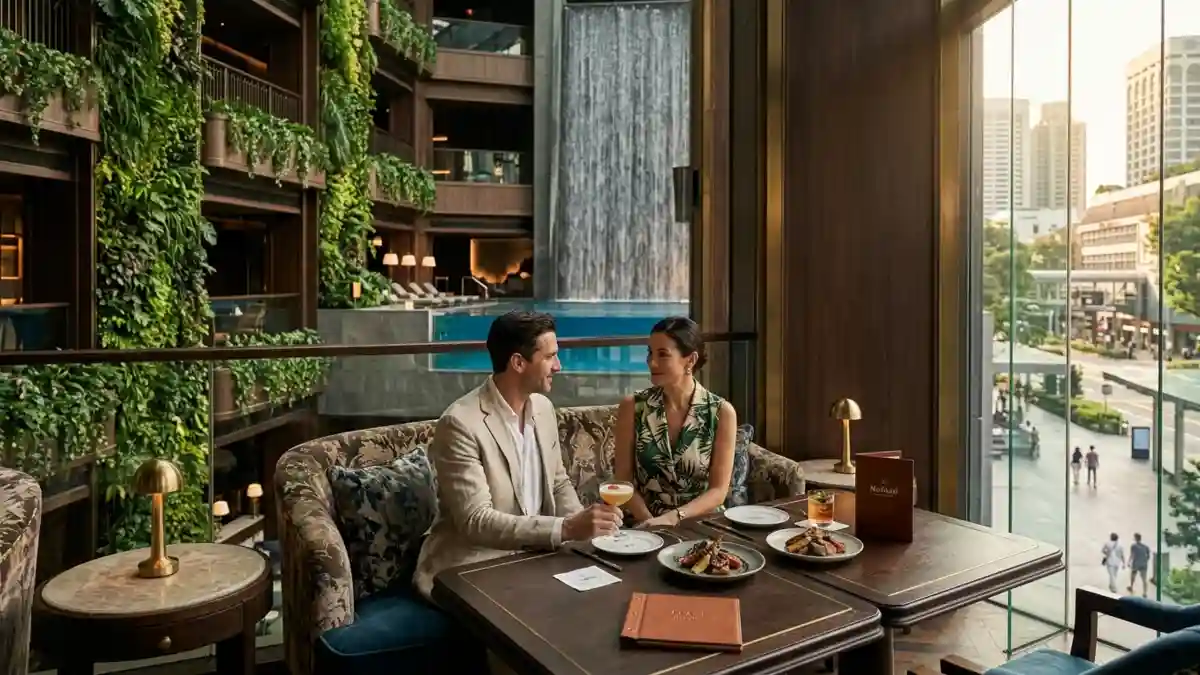
A defining element of the property is its architectural design, led by the acclaimed Singaporean firm WOHA Architects. Known globally for their pioneering work in sustainable, green high-rises, WOHA has designed a structure that directly incorporates natural elements into the urban landscape. The exterior features a verdant, cliff-like facade covered in rich tropical plantings, highlighted by a striking 15-story cascading waterfall that drops down the front of the building.
15-Story Exterior Waterfall: Acts as a natural cooling mechanism and a distinct visual marker on Orchard Road.
Level 3 Urban Verandah: A dedicated public space designed to host community art and design programs, showcasing local Singaporean talent.
Level 5 Sky Terrace: Houses the main hotel reception, creating a elevated transition zone that separates the street-level retail from the guest spaces.
This architectural approach creates a striking aesthetic while addressing the urban heat island effect, aligning with Singapore’s broader “City in Nature” initiative. By bringing the outdoors inside through open air spaces and living walls, the building serves as an illustrative example among top design hotels Asia, demonstrating how high-density urban architecture can successfully coexist with natural ecosystems.
4. Accommodation Analysis: Boutique Hotel Suites Singapore
With 173 meticulously curated rooms, the property focuses on custom interiors rather than uniform layouts. Based on available information, the rooms are designed with a residential feel, featuring bespoke artwork, rich textiles, and architectural details that reflect local cultural motifs. The accommodations range from well-appointed king rooms to spacious boutique hotel suites Singapore, targeting travelers who appreciate detailed craftsmanship and unique interior design.
[Typical Suite Configuration Concept]
┌────────────────────────────────────────────────────────┐
│                                                        │
│   Bedding Area: Custom Linens & Hardwood Flooring     │
│                                                        │
├──────────────────────────────┬─────────────────────────┤
│                              │                         │
│   Living Space: Curated Art  │   Marble Bathroom:      │
│   & Residential Seating      │   Premium Fixtures      │
│                              │                         │
└──────────────────────────────┴─────────────────────────┘
The suites avoid the sterile, corporate look common in many modern business hotels. Instead, they utilize custom furniture, layered lighting schemes, and standalone bars to create an atmospheric, historic environment. While families requiring expansive multi-room complexes might find traditional family resorts more suitable, these boutique suites are well-tailored for couples, solo design enthusiasts, and business travelers looking for an inspiring workspace within the city.
5. Direct Comparison: NoMad vs Mondrian Singapore
For travelers evaluating luxury lifestyle accommodations APAC, understanding how different brands execute their lifestyle concepts is essential. A common comparison is NoMad vs Mondrian Singapore Duxton, which opened in the vibrant Chinatown enclave. While both properties operate within the premium lifestyle segment and eschew traditional corporate design, their execution, location, and overall atmosphere differ significantly.
| Feature / Attribute | NoMad Hilton Singapore (Orchard Road) | Mondrian Singapore Duxton (Chinatown) |
| Primary Location Context | Prime retail corridor, central Orchard Road shopping district. | Creative heritage district, close to independent dining and nightlife. |
| Architectural Style | Biophilic high-rise designed by WOHA with a 15-story waterfall. | Modernist block integrated with low-rise historic shophouse surroundings. |
| Interior Vibe | Historic New York glamour mixed with local craftsmanship. | Clean, contemporary art-focused interiors with bold pop-art elements. |
| F&B Strategy | Integrated venues overseen by a unified global culinary team. | Independent, high-energy dining concepts and neighborhood bars. |
| Inventory Scale | 173 rooms and suites, emphasizing residential privacy. | 302 rooms and suites, designed for a high-energy social scene. |
This comparison highlights a distinct difference in lifestyle philosophies. The Mondrian options lean into a youthful, contemporary art-led energy rooted in a creative dining neighborhood. In contrast, the NoMad model relies on a more classical, old-world sophistication, providing an oasis of European-American glamour directly inside the city’s busiest commercial shopping district.
6. The Culinary Ecosystem: Unified Destination Dining
NoMad properties have long been recognized for treating their food and beverage programs as primary anchors rather than secondary hotel amenities. In Singapore, this strategy is executed through four distinct concepts spanning from the ground level up to the rooftop, designed to attract both international hotel guests and local culinary enthusiasts.
[Culinary Program Distribution]
  Level 19: Rooftop Lounge ──> Panoramic Orchard views & premium spirits
  Level 05: Poolside Lú Bar ──> Relaxed aperitivo service & heron-inspired art
  Mid-Tower: The Tropicana Club ──> 1950s cabaret style & elevated classic cocktails
  Street/Lobby: NoMad Grill ──> Wood-fired chophouse & traditional brasserie service
The culinary program is led by newly appointed global culinary director Josh Harnden, a veteran of Michelin-starred kitchens such as Eleven Madison Park, alongside director of culinary Lorenz Hoja, who spent over a decade working with the legendary chef Joël Robuchon. The beverage program is guided by award-winning mixologist Leo Robitschek.
The primary dining room, NoMad Grill, combines a classic European brasserie with a traditional New York-style chophouse, focusing on dry-aged meats prepared over open wood fires. On the street-facing side, Sticky Fingers functions as a gourmet soft-serve parlor by day before transforming into an intimate dessert and cocktail lounge at night.
For evening entertainment, The Tropicana Club pays homage to the historic 1950s Singapore entertainment complex of the same name, blending mid-century cabaret glamour with a precise cocktail program built around elevated Martinis, Manhattans, and tropical classics. Finally, Lú Bar offers a quieter poolside retreat on the sky terrace, serving lighter aperitivo-style drinks surrounded by lush greenery.
7. Comparative Context: Singapore Luxury Resort Comparison
When deciding where to stay in the city, it helps to evaluate how an urban lifestyle boutique hotel compares to the city’s famous luxury resorts and grand heritage properties. This Singapore luxury resort comparison outlines how different property types serve distinct travel styles.
Urban Lifestyle Hotels (e.g., NoMad, Mondrian): Best suited for travelers who prioritize design, dining, and immediate access to city infrastructure. These properties focus on high-energy public spaces, curated cocktail bars, and neighborhood connectivity.
Island Resorts (e.g., Sentosa-based properties): Ideal for families and leisure travelers seeking large-scale wellness facilities, expansive private grounds, beach access, and a complete escape from the urban environment.
Grand Heritage Hotels (e.g., Raffles Singapore): Tailored for history enthusiasts and traditional luxury travelers who prefer classical colonial architecture, formal butler service, and an institutional sense of quiet luxury.
For travelers looking for premium hotel brand alternatives to standard corporate five-star towers, an urban lifestyle hotel offers a compelling middle ground. It delivers the high-end amenities and precise service expected of a top-tier hotel, but presents them within an environment that feels creative, contemporary, and deeply connected to local culture.
8. Practical Planning and Guest Insights
For travelers planning a visit to Singapore in late 2026 or early 2027, timing and property selection are key to maximizing the experience. The city operates as a year-round destination, though specific periods bring increased demand and distinct regional appeal.
Choosing the Right Season
While Singapore experiences consistent tropical weather throughout the year, travel patterns fluctuate based on major regional events. The cooler, breezier months between November and January often bring festive lighting displays along Orchard Road, placing the hotel at the center of the city’s seasonal celebrations. Conversely, travelers visiting during the spring or mid-year periods will find a more business-focused atmosphere, making it an excellent time to experience the hotel’s cultural and art programming on the Urban Verandah with fewer crowds.
Transportation and Arrival
Arriving from Changi International Airport takes approximately 20 to 25 minutes by taxi or private vehicle via the East Coast Parkway (ECP). For those preferring public transportation, the direct integration of Singapore’s MRT network makes moving across districts efficient. Guests staying at Orchard Road can easily reach the Marina Bay financial core in under 15 minutes via the North-South Line, making the location highly practical for split itineraries that combine business meetings with weekend leisure exploration.
Stay sharp with Feast and Rest.
Source and Data Limitations
Primary Information Sources: Project updates and corporate announcements from Hilton Global Media Center, architectural design portfolios from WOHA Architects, development briefs from UOL Group Limited, and culinary program releases from Sydell Group.
Project Timeline Details: While current company press updates point to an opening in late 2026, certain regional real estate reports indicate that full commercial operations and public bookings might adjust into early 2027 due to final interior fit-outs and pre-opening culinary trials.
Data Restrictions and Exclusions: Because the property is currently under construction, specific room rates, exact menu pricing, and direct guest service reviews are unavailable. This preview excludes unverified social media speculation regarding potential future celebrity chef partnerships beyond the officially announced culinary leadership team of Josh Harnden, Lorenz Hoja, and Leo Robitschek. All descriptions of interior spaces and structural finishes are based on confirmed architectural blueprints and official design renderings.