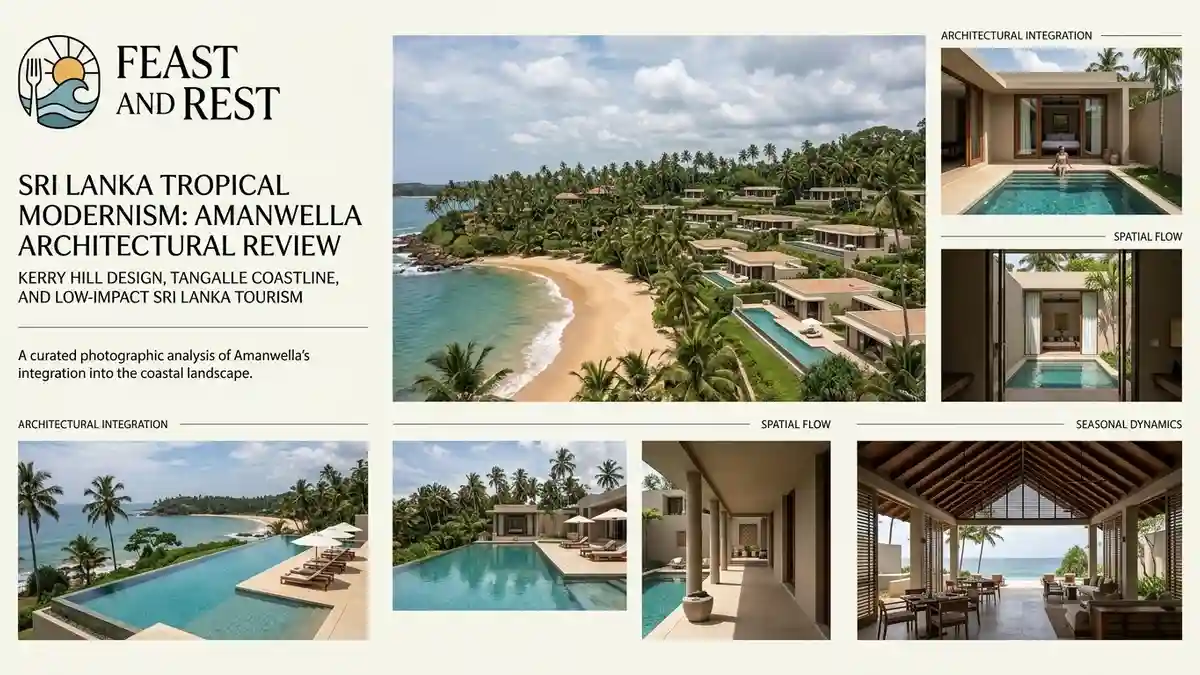
An architectural evaluation of Amanwella in Tangalle reveals how Kerry Hill’s contemporary design interprets Geoffrey Bawa’s tropical modernism on Sri Lanka’s southern coast. Set along an 800-meter crescent beach framed by a mature coconut grove, the 30-suite resort demonstrates how low-impact spatial design integrates high-end hospitality with local coastal ecosystems. For luxury destination planners and design-focused travelers, analyzing this property yields key insights into architectural heritage preservation, regional economic integration, and seasonal coastal dynamics.
An Amanwella luxury resort review must evaluate how the property balances spatial privacy with environmental context. Built using local terracotta tiles, hand-carved indigenous stone, and porous timber screens, the resort functions as an open-air sanctuary that prioritizes natural cross-ventilation over artificial cooling. The property stands as a operational case study in low-density resort master planning. Situated within driving distance of the Sri Lanka Tourism Development Authority (SLTDA) southern corridor, it anchors regional luxury travel without disrupting the artisanal fishing economy of the neighboring Wella Wathura community.
+-----------------------------------------------------------------------------------+
|                            AMANWELLA AT A GLANCE                                  |
+--------------------------+--------------------------------------------------------+
| Architectural Style      | Tropical Modernism (Designed by Kerry Hill Architects) |
| Footprint & Density      | 30 Suites across 37 acres of coconut grove & coast     |
| Beach Access             | 800-meter crescent beach (shared coastal zone)         |
| Core Materials           | Terrazzo, indigenous granite, teak, terracotta tiles   |
| Primary Intent           | Low-impact architectural destination planning          |
+--------------------------+--------------------------------------------------------+
Spatial Master Planning and Architectural Lineage
The layout of Amanwella draws directly from the principles of Sri Lankan tropical modernism, an architectural movement pioneered by Geoffrey Bawa in the mid-20th century. Late Australian architect Kerry Hill translated these principles into a grid of long, clean horizontal lines and open pavilions. Rather than constructing a monolithic hotel block, the master plan scatters 30 identical 100-square-meter suites along a terraced hillside facing the Indian Ocean. This terraced arrangement preserves the existing contours of the terrain, minimizing land grading and protecting the native root structures of the surrounding coconut palms.
Each suite operates as a self-contained spatial circuit. Guests transition through private entrance courtyards into open-plan living quarters, which lead to rear private plunge pools enclosed by stone walls. Floor-to-ceiling floor tracks host sliding floor-to-ceiling timber screens and glass panels, allowing occupants to modify natural light and airflow dynamically. This design choice reduces dependence on HVAC systems while framed views turn the surrounding canopy into an active visual component of the interior architecture.
+------------------------------------------------------------------------------------+
|                         SUITE LAYOUT & SPATIAL FLOW                                |
+------------------------------------------------------------------------------------+
| [ Entrance Courtyard ] ---> [ Open-Plan Living / Bedroom ] ---> [ Ocean Terrace ]  |
|                                         |                                          |
|                                         v                                          |
|                              [ Freestanding Bathroom ]                             |
|                                         |                                          |
|                                         v                                          |
|                              [ Private Plunge Pool ]                               |
+------------------------------------------------------------------------------------+
The central focal point of the resort’s public space is a 47-meter infinity pool constructed on a elevated rocky promontory. Elevated above the tide line, the pool reflects the sky while creating a visually seamless transition to the ocean horizon. The adjacent dining pavilion and lounge bar use soaring open-gabled roofs clad in regional clay tiles. This structure channels thermal currents upward and away from guests, providing passive cooling during peak afternoon heat.
Key Facts: Architectural and Infrastructure Metrics
Master Architect: Kerry Hill Architects (opened 2005).
Total Accommodations: 30 freestanding suites (Garden, Ocean Hill, Ocean, and Premium Ocean variants).
Suite Footprint: 100 square meters (1,076 square feet) including internal courtyard and ocean-facing terrace.
Central Pool Length: 47 meters, positioned on the main public terrace.
Shoreline Frontage: 800 meters of golden-sand bay frontage along the Southern Province coastline.
Transit Access: 2.5-hour highway drive from Bandaranaike International Airport (CMB) via the Southern Expressway (E01) or a 15-minute transfer from the Dickwella aerodrome.
What the Data Shows: Seasonal Monsoonal Dynamics
Planning an itinerary to Tangalle requires understanding the dual-monsoon system governed by the Department of Meteorology of Sri Lanka. The southern coast experiences weather pattern shifts driven by the Southwest (Yala) Monsoon and the Northeast (Maha) Monsoon.
+-------------------------------------------------------------------------------------------------------+
|                               SEASONAL CLIMATE & SEA CONDITIONS MATRIX                               |
+---------------------+-------------------+------------------------+------------------------------------+
| Season              | Months            | Coastal Conditions     | Destination Utility                |
+---------------------+-------------------+------------------------+------------------------------------+
| Peak Dry Season     | December – April  | Calmer seas, high clarity | Swimming, coastal walks, marine life|
| Yala Monsoon        | May – September   | Strong swells, heavy rain| Surfing, low-occupancy quiet stays |
| Inter-Monsoonal Transit | October – November| Moderate rain, mixed sea | Cultural excursions, temple visits |
+---------------------+-------------------+------------------------+------------------------------------+
Data from Sri Lanka Tourism Development Authority arrival reports indicates that peak occupancy along the southern coast occurs between December and April, coinciding with dry conditions and calm sea currents. During this period, offshore wave heights average under 1.5 meters, enabling safe swimming within the bay’s protected western corner.
Conversely, the Southwest Monsoon between May and September brings heavier swells exceeding 2.5 meters. While these conditions limit ocean swimming, they create optimal break points for experienced surfers along nearby headlands like Hiriketiya Bay. Rates during these months drop by 30% to 45% compared to peak winter periods, presenting a comparative entry window for design professionals and research-oriented travelers evaluating the physical resort infrastructure in quiet surroundings.
Why This Matters: Heritage Access and Regional Ecotourism
Amanwella functions as an architectural base camp for exploring the cultural and ecological heritage of Hambantota and Matara districts. Positioned far from high-density resort enclaves, the property provides access to ancient Buddhist sites, coastal wildlife reserves, and traditional community zones.
+------------------------------------------------------------------------------------+
|                          REGIONAL EXCURSION DISTANCES                              |
+--------------------------------+--------------------+------------------------------+
| Destination                    | Distance / Time    | Primary Heritage / Eco Value |
+--------------------------------+--------------------+------------------------------+
| Mulgirigala Rock Temple        | 20 km (35 mins)    | 2nd-century BCE monastic site|
| Rekawa Sanctuary               | 15 km (25 mins)    | Marine turtle nesting bay    |
| Udawalawe National Park        | 65 km (75 mins)    | Asian elephant habitat       |
| Galle Fort UNESCO Site         | 75 km (90 mins)    | 17th-century fortification   |
+--------------------------------+--------------------+------------------------------+
The Mulgirigala Rock Temple sits inland on a 205-meter monolithic rock outcrop. Dating back over 2,000 years, the site contains five cave complexes housing ancient wall murals, reclining Buddha statues, and rare palm-leaf manuscripts preserved in the monastic library. Guests visiting from Tangalle can explore these early Sinhalese religious artworks away from standard commercial tour routes.
For ecological conservation, the coastal village of Rekawa features a critical nesting beach monitored by the Turtle Conservation Project (TCP). Five of the world’s seven sea turtle species—including the green, hawksbill, and leatherback—lay eggs along this shore. Nighttime guided visits follow strict non-intrusive protocols without white flashlights or artificial audio, generating local conservation revenue while preserving natural nesting behavior.
Societal and Sustainability Impact
The presence of a low-density luxury property impacts local marine resource management and employment structures in Tangalle. The resort’s beach borders an active artisanal fishing landing site. Rather than enclosing the shoreline behind physical barriers, the master plan maintains open public paths. Local fishermen continue to launch outrigger canoes (oruvas) directly from the sand, selling catches directly to the resort’s culinary team.
                                  +-----------------------+
                                  |   Local Fishermen     |
                                  |  (Outrigger Canoes)   |
                                  +-----------+-----------+
                                              |
                                              v
+-----------------------+         +-----------+-----------+         +-----------------------+
|  Local Farmers &      |  Supply |  Resort Kitchens &    |  Direct |  Wella Wathura        |
|  Spice Growers        |-------->|  Culinary Operations  |-------->|  Community Employment |
+-----------------------+         +-----------------------+         +-----------------------+
This direct economic integration extends to regional agriculture. Produce, native spices, and coconut harvests are sourced from farms across Matara district, keeping supply chains hyper-local. On-site waste management practices focus on eliminating single-use plastics, utilizing glass water bottling plants, and composting organic food waste for internal landscape maintenance.
Architecturally, using unpainted render, locally cut stone, and native wood timber means the structural footprint requires lower ongoing lifecycle maintenance compared to imported metallic composites. This design choice prevents chemical runoff into adjacent coastal tide pools, preserving local marine life habitats.
Critical Comparative Evaluation
Evaluating Amanwella within Sri Lanka’s luxury hospitality sector requires comparing its modernist design ethos against historic colonial adaptations elsewhere along the coast.
+--------------------------------------------------------------------------------------------------------+
|                                COMPARATIVE RESORT DESIGN ARCHITECTURE                                  |
+-----------------------+-----------------------------+-----------------------------+--------------------+
| Property              | Architectural Style         | Spatial Integration         | Core Heritage Target|
+-----------------------+-----------------------------+-----------------------------+--------------------+
| Amanwella (Tangalle)  | Tropical Modernism          | Low-density coconut grove   | Coastal seclusion  |
| Amangalla (Galle Fort)| Dutch Colonial Restoration  | Urban historic UNESCO fort  | 17th-century history|
| Anantara Peace Haven  | Contemporary Vernacular     | Cliffside high-capacity     | Family resort hub  |
+-----------------------+-----------------------------+-----------------------------+--------------------+
Unlike its sister property Amangalla—which occupies a restored 17th-century Dutch colonial building within Galle Fort—Amanwella focuses on landscape-driven, minimalist modernism. Where Amangalla emphasizes indoor colonial heritage, antique teak furnishings, and urban fort history, Amanwella prioritizes outdoor spatial flow and raw natural light.
When compared to larger properties like Anantara Peace Haven Tangalle Resort, Amanwella operates at a fraction of the key count (30 suites versus 152 rooms/villas). This lower density offers greater acoustic privacy, lower beachfront foot traffic, and personalized guest service. However, travelers seeking extensive organized children’s facilities, multiple specialty restaurants, or extensive internal transport networks may find Amanwella’s minimalist layout tailored primarily for quiet, independent rest.
Destination Planning Considerations
Executing a trip to Sri Lanka’s southern coast requires planning around regional transit networks, administrative regulations, and seasonal schedules.
+-----------------------------------------------------------------------------------+
|                         PRACTICAL TRAVEL PLANNING CHECKLIST                       |
+-------------------------+---------------------------------------------------------+
| Visa Policy             | Electronic Travel Authorization (ETA) via official portal|
| Transit Route           | E01 Southern Expressway from Colombo (approx. 3 hours)  |
| Health Protocols        | Standard tropical health precautions & reef-safe sunblock|
| Currency Exchange       | Sri Lankan Rupee (LKR) required for local village markets|
+-------------------------+---------------------------------------------------------+
Access and Logistics
Travelers entering via Colombo’s Bandaranaike International Airport (CMB) can reach Tangalle via the E01 Southern Expressway in under three hours. Private vehicular transfers are standard, though domestic sea-plane transfers landing at Dickwella water drome offer a 45-minute air connection. All foreign visitors must secure an Electronic Travel Authorization (ETA) via the official government portal before arrival.
Health and Cultural Etiquette
When visiting religious sites like Mulgirigala, shoulders and knees must remain covered, and shoes must be removed prior to stepping onto temple grounds. Travelers should pack reef-safe sunscreen to protect delicate coastal coral reefs and wear protective watershoes when exploring rocky intertidal zones along Tangalle’s coast.
Stay inspired with Feast and Rest!
Source and Data Limitations
This analytical destination overview relies on architectural documentation, regional climate datasets, and official tourism records. Key sources include architectural archives on Kerry Hill, heritage publications regarding Geoffrey Bawa’s work, the Sri Lanka Tourism Development Authority (SLTDA), and official conservation briefs from the Turtle Conservation Project (TCP). Room rates, seasonal occupancy patterns, and transit durations are derived from industry reports collected through 2025 and 2026.
Limitations: On-site ocean conditions vary daily based on localized wind patterns, and sea-swimmer safety must be re-evaluated on a daily basis despite broad seasonal trends. Proprietary hotel operating metrics, internal financial returns, and private community agreements remain confidential and are omitted from this analysis.