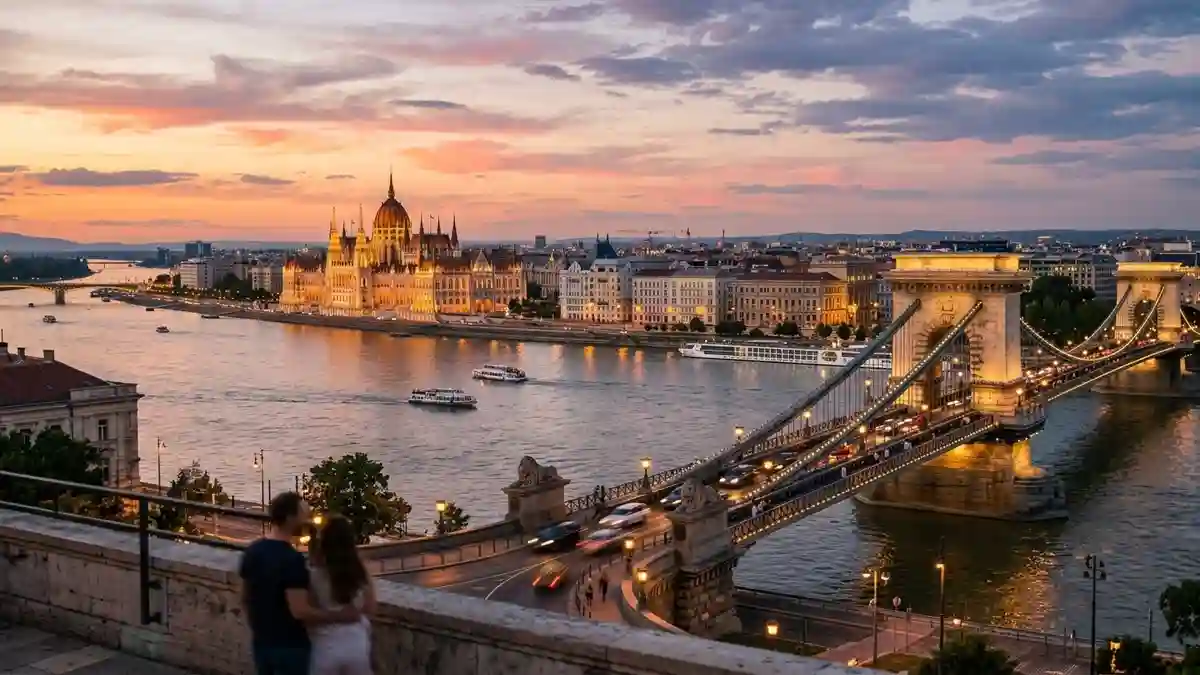
What Is Budapest Cultural Tourism? A Heritage Overview
Budapest cultural tourism represents an integrated heritage framework built upon distinct architectural layers, natural thermal hydrology, and living urban traditions along the Danube River. Formed in 1873 through the unification of Buda, Óbuda, and Pest, the capital of Hungary balances medieval castle quarters with 19th-century Neo-Gothic civic monuments and modern urban regeneration.
For global travelers researching destination planning, Budapest cultural tourism offers three core dimensions: physical architectural conservation anchored by UNESCO World Heritage designations, an active thermal bath culture dating back to Ottoman and Roman eras, and a dynamic contemporary culinary scene. The city’s geographic layout split by the Danube provides a clear structural narrative between the historic hills of Buda and the commercial plain of Pest.
+-------------------------------------------------------------------------------+
|                       BUDAPEST CULTURAL & TRAVEL PROFILE                      |
+--------------------------+----------------------------------------------------+
| Parameter                | Data / Description                                 |
+--------------------------+----------------------------------------------------+
| Country                  | Hungary (Central Europe)                           |
| Unification Date         | 1873 (Buda, Óbuda, and Pest)                       |
| Key Heritage Listing     | Banks of the Danube, Buda Castle Quarter, Andrássy |
| Thermal Bath Inventory   | 120+ mineral springs supplying 12 major bathhouses |
| Primary Peak Season      | May to September; December (Holiday Markets)       |
| Key Transit Hub          | Budapest Ferenc Liszt International Airport (BUD)  |
+--------------------------+----------------------------------------------------+
Why This Matters: The Heritage Architecture and UNESCO Footprint
The cultural identity of Budapest rests heavily on its designated UNESCO World Heritage sites, which encompass the Banks of the Danube, the Buda Castle Quarter, and Andrássy Avenue. These zones reflect pivotal periods of European urban development, particularly the expansion of the Austro-Hungarian Empire in the late 19th century.
Along the Buda bank, the medieval Castle District houses the rebuilt Royal Palace, the 13th-century Matthias Church, and the Fisherman’s Bastion. Opposite on the Pest riverbank stands the Hungarian Parliament Building, designed by architect Imre Steindl and completed in 1904. This landmark represents one of Europe’s finest examples of Neo-Gothic revival architecture, integrating traditional Hungarian motifs into its structural facade.
Andrássy Avenue illustrates 19th-century urban planning, connecting the inner city with Heroes’ Square (Hősök tere). The boulevard is lined with Neo-Renaissance palaces and townhouse residences, culminating at the City Park (Városliget). Beneath Andrássy Avenue runs the Millennium Underground Railway (M1), which opened in 1896 as the first subterranean transit system in Continental Europe and remains fully operational today.
                      +----------------------------------+
                      |    BUDAPEST HERITAGE AXIS        |
                      +----------------------------------+
                                       |
             +-------------------------+-------------------------+
             |                                                   |
   [BUDA HILLS & QUARTER]                             [PEST METROPOLITAN AXIS]
   - Buda Castle Palace Complex                       - Hungarian Parliament Building
   - Matthias Church (13th C.)                        - Andrássy Avenue Boulevard
   - Fisherman's Bastion                              - St. Stephen's Basilica
   - Gellért Hill & Citadel                           - Heroes' Square (Hősök tere)
             |                                                   |
             +-------------------------+-------------------------+
                                       |
                       +---------------+---------------+
                       |   UNESCO DANUBE RIVER CORRIDOR|
                       +-------------------------------+
What the Data Shows: Visitor Trends and Regional Demand
Official statistical reports highlight strong demand within the Budapest cultural tourism sector. Data released by the Hungarian Central Statistical Office (KSH) and the National Economy Ministry confirms that Hungary welcomed nearly 20 million overnight guests nationwide, generating 46.8 million guest nights. International travel demand drove much of this growth, recording a 7.5% increase in foreign guest nights to 24.3 million.
+-------------------------------------------------------------------------------+
|               HUNGARY & BUDAPEST TOURISM PERFORMANCE METRICS                  |
+----------------------------------+---------------------+----------------------+
| Indicator                        | Volume / Metric     | Year-over-Year Trend |
+----------------------------------+---------------------+----------------------+
| Total National Visitors          | ~20 Million         | +7.3%                |
| Total Guest Nights               | 46.8 Million        | +4.3%                |
| Foreign Guest Nights             | 24.3 Million        | +7.5%                |
| Domestic Guest Nights            | 22.5 Million        | +1.1%                |
| Michelin Key Hotel Properties    | 10 Properties       | Concentrated in Pest |
+----------------------------------+---------------------+----------------------+
Budapest functions as the primary economic engine for international arrivals. Accommodation preferences in the capital center heavily on commercial hotels, which capture over 70% of overnight stays, alongside licensed short-term residential apartments. Luxury and boutique hospitality investment in Budapest has grown notably, with ten hotel properties in the capital securing prestigious Michelin Key ratings for architectural integration and service quality.
Thermal Bath Infrastructure: Hydrological Heritage and Public Spas
A defining pillar of Budapest cultural tourism is its ancient thermal bath infrastructure, supported by more than 120 natural thermal springs that yield roughly 70 million liters of mineral-rich water daily. The city’s spa tradition originated with Roman settlements at Aquincum and expanded significantly during Ottoman rule in the 16th and 17th centuries.
+-------------------------------------------------------------------------------+
|                 HISTORIC THERMAL BATHS OF BUDAPEST COMPARISON                 |
+------------------+-------------------+-------------------+--------------------+
| Bath Complex     | Primary Era       | Architectural     | Key Hydrological   |
|                  | Origin            | Style             | Features           |
+------------------+-------------------+-------------------+--------------------+
| Széchenyi Bath   | 1913 (Pest)       | Neo-Baroque       | 21 outdoor/indoor  |
|                  |                   |                   | thermal pools      |
| Rudas Bath       | 1566 (Ottoman)    | Turkish Octagonal | Octagonal dome,    |
|                  |                   | Cupola            | rooftop thermal    |
| Lukács Bath      | 12th/19th Century | Classicist /      | High mineral density|
|                  |                   | Modern            | therapeutic waters |
| Gellért Bath     | 1918 (Buda)       | Art Nouveau       | Zsolnay ceramics,  |
|                  |                   |                   | stained glass      |
+------------------+-------------------+-------------------+--------------------+
The Széchenyi Thermal Bath, located in the City Park, stands as one of the largest public bath complexes in Europe. Powered by a deep thermal well drilled in 1878, the facility’s yellow Neo-Baroque structures house 21 pools. On the Buda bank, the Rudas Bath features a preserved 16th-century octagonal pool beneath an Ottoman stone dome, while the Lukács Thermal Bath has served as a center for balneotherapy and medical spa treatments since the Middle Ages.
According to representatives from Budapest Spas cPlc, the municipal entity managing the historic facilities:
“Bathing in Budapest is not merely a modern wellness trend; it is a centuries-old civic ritual where natural geology meets architectural history.”
For travelers, visiting these bathhouses requires observing local pool etiquette: wearing flip-flops, taking pre-soak showers, and limiting individual thermal soak times to 20–30 minutes per pool to manage physical exertion.
Comparative Analysis: Budapest Alongside Central European Capitals
When evaluating Budapest cultural tourism against neighboring Central European capitals like Vienna and Prague, distinct functional and financial patterns emerge across seasonal travel data.
+-------------------------------------------------------------------------------+
|               CENTRAL EUROPEAN CAPITAL COMPARATIVE FRAMEWORK                  |
+-------------------+--------------------+-------------------+------------------+
| City              | Primary Cultural   | Key Heritage      | Relative Transit |
|                   | Anchor             | Identifier        | & Lodging Index  |
+-------------------+--------------------+-------------------+------------------+
| Budapest, Hungary | Thermal Hydrology  | Austro-Hungarian  | Moderate         |
|                   | & Danube Vista     | & Ottoman Mix     |                  |
| Vienna, Austria   | Imperial Museums   | Habsburg Palaces  | Premium          |
|                   | & Classical Music  | & Fine Arts       |                  |
| Prague, Czechia   | Gothic & Baroque   | Compact Preserved | Moderate to      |
|                   | Urban Core         | Historic Center   | Premium          |
+-------------------+--------------------+-------------------+------------------+
While Vienna emphasizes formal imperial museum collections and high classical performing arts, Budapest integrates its monumental architecture directly with natural balneological resources. Prague features a highly concentrated medieval center, whereas Budapest offers broader riverfront avenues and distinct urban hubs across both sides of the Danube. From a destination planning perspective, Budapest maintains moderate accommodation costs relative to Western Europe, though peak summer occupancy in central districts approaches capacity.
Practical Planning Considerations: Seasons, Access, and Transport
Successful execution of a Budapest travel itinerary depends on seasonal patterns and local transit logistics.
+-------------------------------------------------------------------------------+
|                     SEASONAL PLANNING & VISITOR GUIDANCE                      |
+-------------------+-------------------+---------------------------------------+
| Season            | Temperature Range | Strategic Travel Insights             |
+-------------------+-------------------+---------------------------------------+
| Spring (Mar–May)  | 10°C to 22°C      | Ideal for walking tours; moderate     |
|                   |                   | crowds; cultural spring festivals.    |
| Summer (Jun–Aug)  | 20°C to 32°C      | Peak tourist volume; high outdoor pool|
|                   |                   | activity; higher room rates.          |
| Autumn (Sep–Nov)  | 8°C to 20°C       | Excellent thermal bath conditions;    |
|                   |                   | wine festivals; lower lodging prices. |
| Winter (Dec–Feb)  | -2°C to 6°C       | Christmas markets in Pest; snow at    |
|                   |                   | Buda Castle; high thermal bath demand.|
+-------------------+-------------------+---------------------------------------+
Public transportation within Budapest is operated by the BKK (Budapesti Közlekedési Központ). The network combines four underground metro lines, an extensive tram system, and public buses. Tram Line 2 runs directly along the Pest embankment of the Danube, offering an affordable scenic route past the Hungarian Parliament and major river bridges.
Visitors arriving via Budapest Ferenc Liszt International Airport (BUD) can access the city center using the 100E express bus service direct to Deák Ferenc Square, or via licensed municipal taxicabs. Standard entry requirements follow the Uniform Schengen Area framework for international travelers.
Community Impact and Sustainable Heritage Preservation
The rapid growth of Budapest cultural tourism has prompted municipal authorities to introduce targeted sustainability and community preservation policies. High concentrations of visitors in the inner District VII (Erzsébetváros) and the Buda Castle District have led local councils to implement stricter regulations on short-term residential rentals and evening venue operating hours.
To preserve the urban fabric, the Budapest Municipality and Hungarian Tourism Agency have directed public investment toward decentralizing visitor traffic. Initiatives support eco-tourism trails in the Buda Hills, heritage restoration along the Outer Grand Boulevard (Nagykörút), and structural conservation across municipal thermal baths. These actions ensure long-term balance between civic living conditions and global tourism access.
Stay inspired with Feast and Rest!
—
Source and Data Limitations
This article relies on verified statistical data published by the Hungarian Central Statistical Office (KSH), official press releases from the National Economy Ministry of Hungary, and heritage listings managed by the UNESCO World Heritage Centre. Thermal spring specifications and historical bath details are sourced from official publications by Budapest Spas cPlc (Budapest Gyógyfürdői és Hévízei Zrt.) and the European Historic Thermal Towns Association (EHTTA).
Limitations: Short-term private rental projections remain subject to evolving municipal regulations in Budapest’s central districts. Unverified commercial hotel forward-booking claims and private tour operator promotional projections were excluded to maintain factual accuracy and editorial independence.