Shifting Dynamics in World Cup 2026 Hotel Bookings
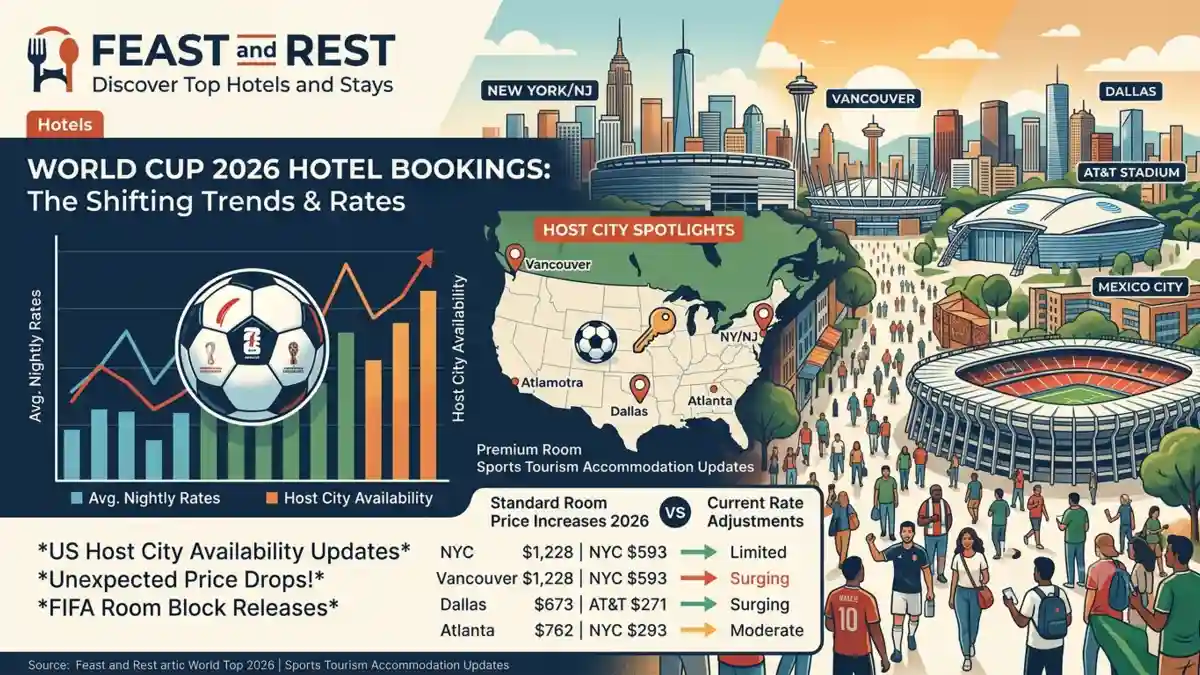
The landscape of World Cup 2026 hotel bookings is turning out to be quite different from what early industry forecasts predicted. For months, travelers and sports enthusiasts were warned to secure accommodations years in advance to avoid a total inventory wipeout. However, real-time market data reveals a far more nuanced environment. While marquee match dates and knockout rounds continue to command premium rates, overall occupancy across several primary markets has arrived softer than initially anticipated.
This unexpected shift is a result of a combination of factors, including aggressive early pricing by lodging companies and significant updates regarding hotel inventory allocation news. Initially, massive room blocks were sequestered for tournament officials, corporate partners, and international delegates. As the tournament progressed, a substantial portion of these contracted blocks was released back onto the open market, suddenly altering US host city hotel availability. Consequently, travelers who held off on making early arrangements are finding a surprisingly flexible marketplace, though navigating the price disparities still requires a strategic approach.
For international spectators and domestic fans alike, understanding these supply-and-demand mechanics is essential. The initial “sticker shock” driven by steep standard room price increases 2026 led many aspirational buyers to rethink their travel plans or seek alternative lodging arrangements, such as short-term vacation rentals. This has forced traditional hoteliers in several major metro areas to recalibrate their expectations and offer more realistic rates for non-marquee group-stage dates. Understanding how individual host cities are performing can help travelers make highly informed choices as they plan their itineraries.
Analyzing US Host City Hotel Availability and Regional Disparities
The availability of accommodations varies significantly depending on the specific region and city infrastructure. Data from major hospitality analytics groups reveals that hotel bookings in U.S. host cities are pacing somewhat behind their Mexican and Canadian counterparts. While cities like Mexico City and Guadalajara have reported robust, steady occupancy rates well over 60% during match weeks, several major American hubs are seeing typical or even slightly lower year-over-year occupancies for the early summer season.
In major metropolitan areas with massive hotel inventories, the sheer volume of rooms has absorbed tournament demand without triggering a city-wide supply crisis. For example, in Dallas and Houston, nearly 70% of hoteliers report that booking paces are largely in line with a normal June or July. Dallas’s AT&T Stadium is hosting nine matches—the highest volume of any venue—yet the sprawling hotel infrastructure of the Dallas-Fort Worth metroplex has kept the overall market stable.
Conversely, smaller markets or those with tighter inventory constraints near their respective stadiums face a different reality. Boston, Seattle, and Philadelphia have reported much softer-than-expected traditional bookings, with roughly 80% of local properties tracking below original projections. This trend is partially attributed to the distance between city centers and the actual sporting venues, prompting fans to make practical decisions about staying in secondary or neighboring markets rather than downtown hotel districts.
Understanding Standard Room Price Increases 2026 vs. Market Adjustments
While a city-wide sellout has not materialized everywhere, standard room price increases 2026 remain highly pronounced on specific match eves. Across the 16 host cities, nightly rates span a massive financial spectrum. On the lower end, cities like Houston and Atlanta offer some of the most budget-friendly options, with average nightly rates hovering around $205 to $220. These markets present a minimal match-day premium, making them highly attractive for fans looking to maximize their trip budget.
On the other side of the spectrum, cities with limited inventory or highly concentrated demand are seeing dramatic price surges. Vancouver has emerged as one of the most expensive host cities, with average nightly rates climbing to around $1,228 (approximately CAD 1,670). A combination of strict local short-term rental laws, a baseline room shortage, and high tournament interest has driven downtown Vancouver rates well above standard seasonal averages. Similarly, the New York/New Jersey metro area is seeing rates average $593 a night across both sides of the Hudson River, with prices climbing into four figures for the final week leading up to the July 19 championship match at MetLife Stadium.
Overview of Host City Hotel Metrics
| Host City | Average Nightly Rate | Match-Day Premium Trend | Typical Availability Status |
| Houston | $205 | Minimal (+8.3%) | High / Readily Available |
| Atlanta | $220 | Low | Moderate to High |
| Dallas | $271 | Minimal (+2.6%) | High (Deep Local Supply) |
| Philadelphia | $297 | Moderate (+6.1%) | Moderate |
| Los Angeles | $383 | Moderate (+9.7%) | Tightening near Venue |
| New York / NJ | $593 | Extreme (Final Week) | Limited near Stadium |
| Boston | $611 | High (+41.5%) | Moderate (Slower Pace) |
| Vancouver | $1,228 | Extreme (+54.6%) | Very Limited / Scarce |
Premium Room Availability FIFA Mandates and the Luxury Sector
The high-end hospitality sector has operated under strict parameters due to premium room availability FIFA regulations. Historically, football’s governing body secures massive allocations of four- and five-star properties to house teams, executives, VIP sponsors, and media partners. According to available hotel industry updates, FIFA initially reserved up to 70% to 80% of premium room blocks in key cities like Boston, Los Angeles, and Seattle.
Because these blocks were tied up during the peak planning phases of late last year, regular corporate travel, conventions, and non-sports tourists chose to postpone or entirely cancel their summer bookings in these cities. This displacement of baseline tourism created an artificial sense of scarcity. When the official corporate and media allocations were finalized, thousands of these premium rooms were quietly returned to the public booking channels.
For the discerning traveler, this means that premium inventory at luxury boutique properties and international five-star chains is actively trickling back into the market. While prices remain elevated to protect average daily rates (ADR), the absolute lockout that many feared has dissipated. Luxury consumers are now able to find club-level rooms and high-end accommodations that were completely unbookable just a few months ago.
Capitalizing on Last Minute Booking Windows and Changing Inventory
As the tournament moves through its active phases, the opening of last minute booking windows presents a unique window of opportunity for flexible travelers. The primary lesson from this summer’s sports tourism cycle is that the rigid booking playbooks of the past do not entirely apply to a tournament spread across three massive North American nations.
For non-marquee group matches or games featuring neutral teams, hoteliers who over-priced their rooms early on are dropping their rates to fill empty beds. Travelers who monitor major booking platforms are frequently finding sudden flash discounts or relaxed minimum-stay requirements.
However, a split strategy is highly recommended based on the tier of the match:
For Knockout Rounds & High-Profile Matches: If you hold tickets for the quarter-finals, semi-finals, or matches featuring highly supported global squads, do not wait for a last-minute drop. These specific dates remain incredibly scarce, and rates near the venues will stay premium.
For Mid-Tier Group Matches: If you are attending group-stage games in softer markets, there is less urgency. Booking a few days before arrival can yield excellent value as hotels drop rates to secure baseline occupancy.
Managing Luxury Suite Reservations and Elite Sports Packages
For ultra-high-net-worth individuals and corporate entities, luxury suite reservations and elite travel packages have largely bypassed standard booking platforms altogether. Official corporate hospitality packages, managed exclusively through authorized providers like On Location, combine premium stadium seating with curated hospitality lounges, gourmet dining, and high-end logistics.
In the hotel space, certain flagship luxury properties have taken highly aggressive approaches to capitalizing on the influx of elite sports tourism. For instance, high-end properties on New York’s Upper East Side have actively marketed multi-floor private takeovers complete with helicopter transfers to the stadium, commanding price tags upwards of $1 million. In Boston and Manhattan’s Meatpacking District, boutique luxury properties continue to offer high-tier packages that bundle private round-trip transportation to the venues with premium champagne welcomes and dedicated concierge services.
These ultra-luxury reservations remain highly insulated from the broader market dips. While standard tourist demand has fluctuated, the corporate demand for elite, secure, and seamless VIP experiences remains robust, keeping the top 1% of the hospitality market firmly anchored to premium pricing.
Strategic Planning Tips for Moving Between Host Cities
Navigating the logistical realities of World Cup 2026 hotel bookings requires looking past the immediate vicinity of the stadiums. Because many of the match venues are located in suburban areas rather than downtown cores—such as Gillette Stadium in Foxborough or AT&T Stadium in Arlington—staying right next to the pitch is often both prohibitively expensive and logistically isolating.
To maximize comfort and value, travelers should consider the following practical insights:
Leverage Surrounding Hubs: Data indicates that secondary cities neighboring the official host hubs are experiencing significant spikes in traveler interest because they offer better value. For instance, Fort Worth, Texas, has seen a multi-fold increase in booking intent compared to downtown Dallas, providing a more relaxed, culturally rich alternative at a fraction of the cost.
Prioritize Transit Connections: Before finalizing a reservation, map out your match-day transit. In cities like Atlanta, utilizing the regional rail network (MARTA) is highly recommended to bypass gridlock. In New York, public transit options to the stadium remain the most practical route, saving travelers hundreds of dollars in rideshare surge fees.
Check Cancellation Policies Carefully: Given the unpredictable nature of tournament advancement, always prioritize booking flexible rates. Opt for properties that offer free cancellation windows of at least 5 to 7 days out, allowing you to pivot your accommodations if your preferred team advances to a different host city.
Ultimately, this summer’s hospitality market proves that sports tourism is evolving. By staying flexible, analyzing local inventory, and looking beyond the primary stadium neighborhoods, soccer fans can secure excellent accommodations without falling prey to early market hype.
Stay sharp with Feast and Rest.
Source and Data Limitations
Data Foundations: This analysis utilizes summer 2026 lodging metrics compiled by the American Hotel & Lodging Association (AHLA) and hotel intelligence platforms such as CoStar and Lighthouse.
Regional Trends: Specific city insights are based on post-draw booking paces, Expedia Group traveler intent indicators, and official press announcements from regional hoteliers in key markets like Dallas, Toronto, and Vancouver.
Hospitality Specifics: Information regarding premium and VIP tiers is drawn from the official FIFA 2026 Accommodation Bureau and authorized corporate hospitality providers.
Data Limitations: Because the tournament is actively occurring, real-time occupancy rates fluctuate rapidly based on team qualification and last-minute fan travel. Early, hyper-inflated predictive models from 2024 and 2025 regarding mandatory 300% price hikes across all markets have been intentionally discounted, as real-world demand has proven to be far more elastic and market-corrected.
To get a closer look at how some fans are navigating the financial realities of these accommodations firsthand, check out this Vancouver World Cup Hotel Cost Report. This news segment highlights the stark pricing challenges and room shortages impacting major Pacific Northwest travel hubs during the tournament.