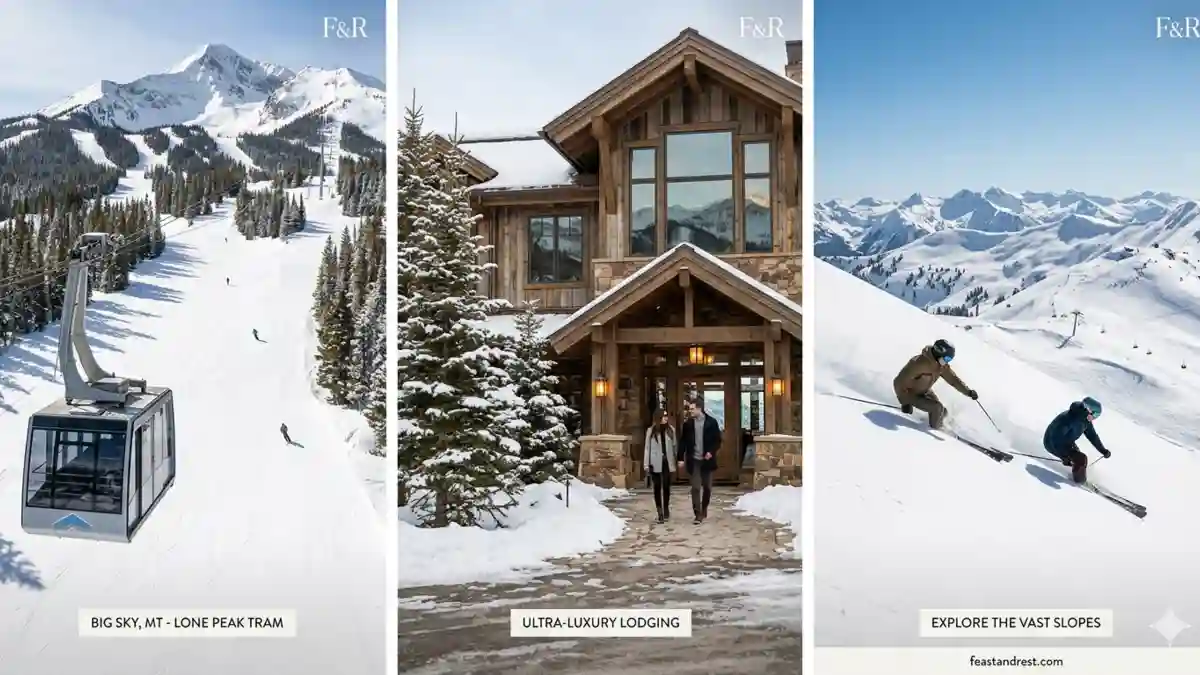
The landscape of North American alpine travel is undergoing a significant transformation as Big Sky Montana emerges as a primary competitor to established hubs like Aspen and Vail. According to the Expedia Group Unpack ’26 report, Big Sky has secured the position of the #1 trending global destination, recording a 92% increase in year-over-year search activity. This growth is driven by three distinct factors: a multi-year $150 million investment in high-speed lift technology, the introduction of ultra-luxury hospitality brands previously absent from the region, and a shift in traveler preference toward the “expansive space” model over congested traditional village centers.
Why Big Sky Montana is outpacing traditional ski resorts this season is best understood through its physical scale. Spanning 5,850 acres of skiable terrain, the resort offers an average of two acres per skier during peak periods—a density ratio significantly lower than many Colorado counterparts. This “uncrowded” value proposition, combined with the 2026 opening of the One&Only Moonlight Basin, has repositioned the Gallatin Range from a rugged alternative to a premier luxury destination.
What the Data Shows: The Growth of Big Sky
Recent metrics from Visit Big Sky and Ski Area Management (SAM) indicate that while global skier visits reached a record 399 million in the 2024–25 season, the distribution of these visitors is shifting toward “high-capacity” regional hubs. Big Sky’s internal data highlights that the new Lone Peak Tram, which travels at 10 meters per second, has effectively decoupled the mountain’s vertical access from the traditional “wait-time” bottlenecks seen at smaller or older resorts.
Infrastructure as a Catalyst for Destination Planning
The primary reason Why Big Sky Montana is outpacing traditional ski resorts this season is its aggressive adoption of “D-Line” lift technology. The resort now operates the Explorer Gondola and Madison 8, the latter being the world’s longest eight-place chairlift. These upgrades are not merely for comfort; they represent a fundamental change in mountain logistics, allowing the resort to move 42,000 skiers per hour uphill, effectively neutralizing the “lift line” friction that often degrades the experience at legacy resorts.
Furthermore, the 2026 season marks the debut of Kircliff, an all-glass viewing platform situated at 11,166 feet. This addition caters to the growing “scenic traveler” demographic—visitors who may not ski but seek high-alpine cultural and visual experiences. By diversifying the utility of the mountain top, Big Sky is successfully attracting a broader segment of the global tourism market than resorts focused solely on downhill athletics.
Why This Matters: The New Luxury Frontier
The entry of One&Only Resorts into the Montana market signals a maturation of the local hospitality sector. Historically, Big Sky was characterized by rustic lodges and private ranch homes; however, the shift toward “ultra-luxury” is a key reason why Big Sky Montana is outpacing traditional ski resorts this season. The One&Only Moonlight Basin provides 73 guestrooms and 19 secluded cabins, offering a level of privacy and “ski-in/ski-out” exclusivity that competes directly with the Swiss Alps.
“Big Sky’s recognition as the top trending destination underscores a shift toward places where adventure and awe-inspiring landscapes come together without the historical congestion of traditional hubs,” states Brad Niva, CEO of Visit Big Sky.
Seasonal Patterns and Practical Access
For travelers engaged in destination planning, understanding the Big Sky seasonal cycle is vital. Unlike many mid-latitude resorts, Big Sky’s high elevation and northern latitude often extend its “prime” snow conditions well into April. In the 2025–26 season, reports from BestSnow.net indicated that while parts of the Interior Northwest struggled with early thaws, Big Sky maintained 79% of normal snowpack through mid-spring, bolstered by its advanced snowmaking infrastructure.
Peak Season: Late December to February (Best for powder, highest prices).
Shoulder Value: March and April (Best for daylight, high snowfall, “spring break” interest).
Access: Direct flights into Bozeman Yellowstone International Airport (BZN) have increased by 20% to accommodate the surge in 2026 interest.
Societal and Sustainability Impact
As the resort scales, the Big Sky Community Organization and the resort’s ForeverProject have focused on mitigating the “resort town” housing crisis and environmental footprint. The 2030 ForeverProject Master Plan outlines a commitment to net-zero emissions, utilizing 100% clean electricity and pioneering reclaimed water snowmaking in partnership with the Spanish Peaks Mountain Club.
The community impact is also measured through the Big Sky Relief fund, which has invested over $46 million into local livability, including affordable housing for the seasonal workforce. This focus on “Social Sustainability” is increasingly important to modern travelers who prioritize ethical tourism and community-supported destinations.
Cultural Context and Heritage Exploration
Beyond the slopes, Big Sky serves as the gateway to the Greater Yellowstone Ecosystem. Travelers often pair a resort stay with a visit to the Museum of the Rockies in nearby Bozeman, a Smithsonian Affiliate known for its world-class paleontological exhibits. This proximity to Yellowstone National Park and regional heritage sites like the Historic Crail Ranch provides a cultural depth that many “purpose-built” ski villages lack.
Key Facts: Big Sky 2026
Total Trails: Over 300 named runs.
Sustainability Goal: Net Zero by 2030.
Top Tech: North America’s fastest chairlift (Madison 8).
Global Rank: #1 Trending Destination (Expedia Unpack ’26).
The combination of technical superiority, expansive terrain, and a new tier of luxury hospitality provides a clear answer as to why Big Sky Montana is outpacing traditional ski resorts this season. For the global traveler, it represents a pivot away from the crowded past and toward a more efficient, secluded, and technologically advanced future of alpine recreation.
Stay inspired with Feast and Rest!
Source and Data Limitations This report is based on 2025–2026 travel data provided by the Expedia Group Unpack ’26 report and official tourism statistics from Visit Big Sky. Infrastructure details are sourced from Big Sky Resort’s technical specifications and Doppelmayr partnership filings. Comparative snowpack data was retrieved from the BestSnow.net April 2026 Progress Report. Financial and community impact figures are cited from the Big Sky Community Organization 2025 Impact Report. While search intent and booking data indicate a 92% growth trend, these figures represent interest and leading indicators; final seasonal visitation totals are typically released by the National Ski Areas Association (NSAA) after the close of the winter quarter. Heritage information is verified via the Museum of the Rockies and AllTrips historical archives.